
Ducks Keep Multiplying
- Deborah Kade
- 3 hours ago
- 4 min read

"Fine weather for ducks" is a classic ironic idiom used to describe heavy rain. People use it as a lighthearted joke because ducks love water, while traditional proverbs and sayings also link the birds to wet skies. "

Popular Sayings and Idioms
"Nice weather for ducks!" – A very old English joke phrase used when it pours outside.
The same rain that makes us complain can make ducks splash in puddles." It is not about changing the weather, but changing your view.
"Be like a duck. Calm on the surface, and paddling like crazy underneath." Though not strictly about rain, this famous saying fits stormy days.
It is a stormy day in Unterseen, so I'm staying close to home! It may be a nice day for ducks but not for me.
Our friends Lynda, Carolyn and Keith, from England, are visiting family in the neighboring village. We have been meeting up during this week. Lynda and Carolyn know I have a rubber duck collection.
Today, I caught up with emails and K dramas.
Michael and I braved the rain to take the bus out to the Restaurant Pizzeria Landhaus at Manor Farm for pizza.


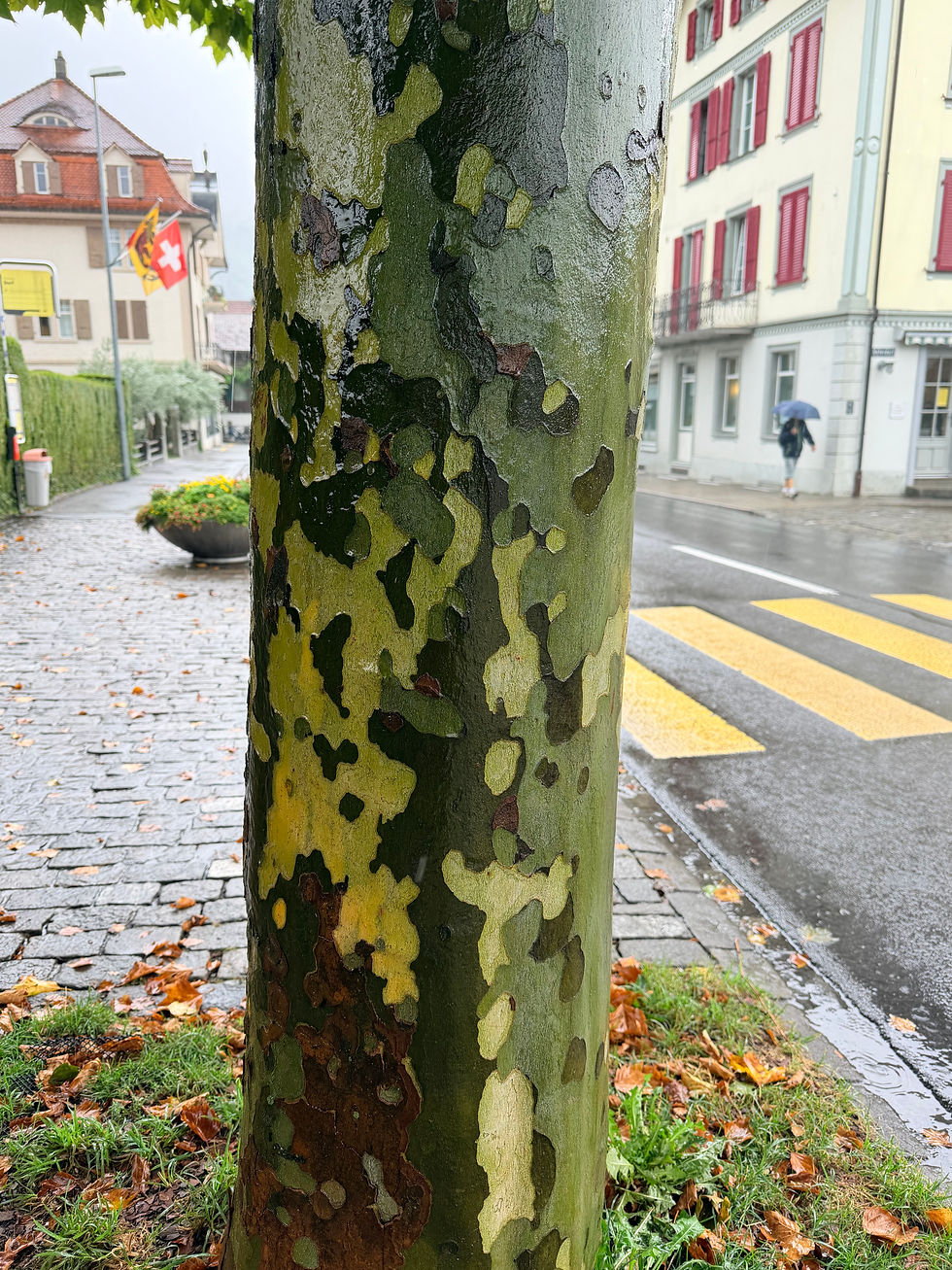
Don't know what type tree this is but the bark is quite interesting. Great camouflage!
Restaurant Pizzaria Landhaus

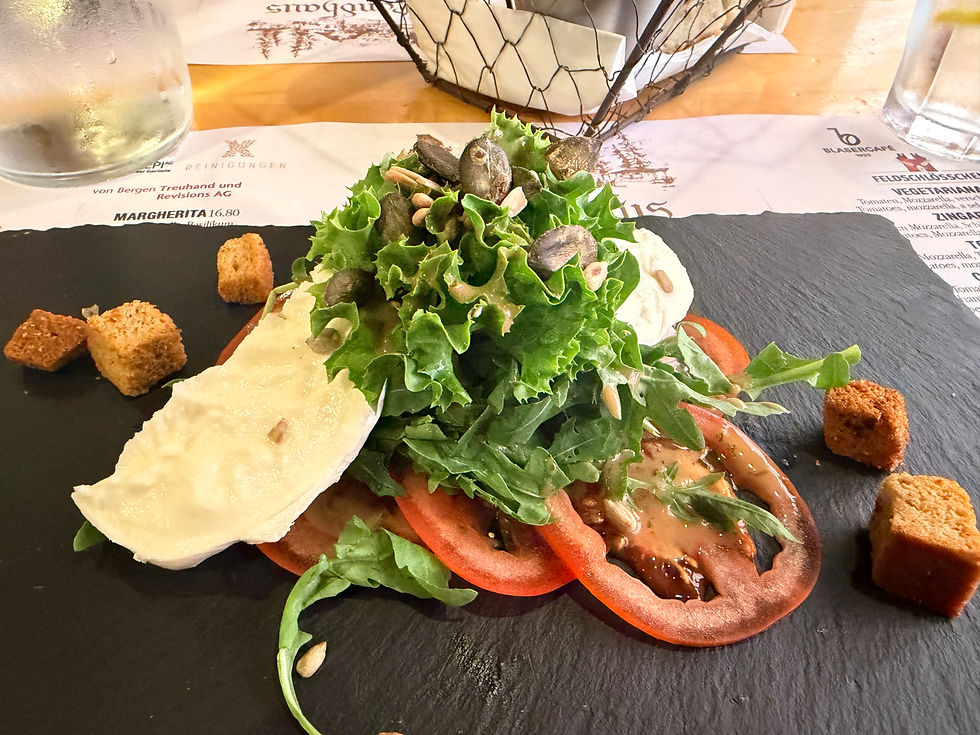
Michael had the mixed salad


Buffalo mozzarella with arugala ans nuts
We both had the Norah pizza


Added spicy oil with the chili peppers. We put the flakes on our pizza's back home

Antiques placed around the rooms. Quite a unique antique tile stove

Schwingen portrait
Schwingen (from German schwingen "to swing"), also known as Swiss wrestling and natively (and colloquially) as Hosenlupf (Swiss German for "breeches-lifting"), is a style of folk wrestling native to Switzerland, more specifically the pre-alpine parts of German-speaking Switzerland. Wrestlers wear Schwingerhosen ("wrestling breeches") with belts that are used for taking holds. Throws and trips are common because the first person to pin their opponent's shoulders to the ground wins the bout.
Schwingen is considered a "national sport" of Switzerland, alongside Hornussen and Steinstossen. Schwingen and Steinstossen were included as Nationalturnen ("national gymnastics") in the Eidgenössisches Turnfest at Lausanne in 1855.
The modern history of organized Schwingen tournaments begins with the Unspunnenfest of 1805.
Unspunnenfest is a festival held in Interlaken, near the old ruin of Unspunnen Castle, approximately once every twelve years, most recently in 2017. The festival highlights traditional Swiss culture and features competitions of Steinstossen (stone throwing), Schwingen (wrestling) and yodeling. The stone-throwing competition uses an 83.5 kg (184.1 lb) stone known as theUnspunnenstein ("Unspunnen Stone"), made of Aare granite from the Hasli valley.
I attended the last Unspunnenfest in 2017. I can't wait for the next one!

"As with other types of folk wrestling, the roots of Schwingen in Switzerland cannot be determined exactly. The modern sport was institutionalized in the 19th century out of older, regional traditions.
There are records of wrestling in Switzerland from the medieval period. A picture from the 13th century (in the Cathedral of Lausanne) shows the typical way of gripping the opponent."
"Schwingen as a special form of grappling in Alpine culture can be traced to the early 17th century. This form of grappling is preserved during the 17th and 18th century in the Emmental, Haslital and Entlebuch regions specifically. In 18th century travel literature, Schwingen figures as part of the stereotypes of Swiss alpine culture. The Entlebuch pastor Franz Josef Stalder in 1797 records a set of rules in his Fragmente über Entlebuch."
"The modern history of the sport begins during the period of Mediation, with the Unspunnenfest of 1805. In the late 19th century, memorable Schwing festivals and a lively activity of educated gymnastics teachers brought Schwingen to the big cities. Thus the original fight of the herders and farmers became a national sport that reached all social levels. The associations, headed by the Eidgenössischer Schwingerverband (national federation, founded 1895), organized the sport by integrating regional peculiarities, improving the abilities of the fighters with teaching books and practices, and creating modern tournament rules."
"The match takes place in a ring, a circular area with a diameter of 12 meters that is covered with sawdust. The two opponents wear short pants made of jute over their clothes. The wrestlers hold each other by these pants, at the back where the belt meets, and try to throw the opponent onto his back. There are several main throws, with names like "kurz", "übersprung" and "wyberhaagge", some of them very similar to judo techniques - "hüfter" is almost identical to koshi guruma, "brienzer" is basically uchi mata. These throws are found in many wrestling systems that have even the slightest emphasis on throwing the opponent, and can also been seen in shuaijiao. A match is won when the winner holds the opponent's pants with at least one hand and both the opponent's shoulders touch the ground. By tradition the winner brushes the sawdust off the loser's back after the match.
The match is judged by three referees, one of whom stands in the ring. The referees give points, with a maximum of ten points for a winning throw. If the match ends without a clear win, the more active Schwinger is awarded the higher number of points."
"There are no weight classes nor any other categories. Usually, though, Schwingers are big men, over 180 cm (71 in) tall and weighing in excess of 100 kg (220 lb), and are mostly craftsmen from traditional professions that require some physical force, like carpenters, butchers, lumberjacks or cheesemakers."



Comments