
What a Difference a Year Makes
- Deborah Kade
- 1 hour ago
- 6 min read

View of the Mönch, the Jungfraujoch, and the Jungfrau on August 31, 2025.
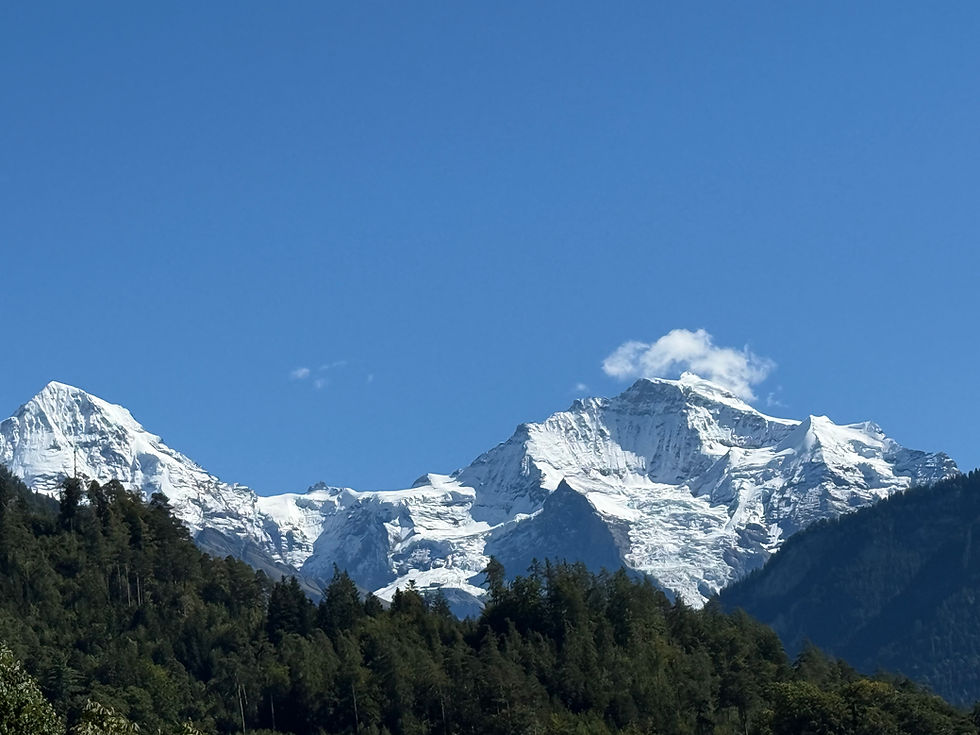
View of the Jungfrau on August 31, 2025

View of the Mönch, Jungfraujoch, and Jungfrau on August 20, 2026
One of Switzerland's best-known ski regions, the Bernese Oberland, has become the first to tally up the cost of climate change to the tourist industry.
"According to a report released on Monday, the impact on the region, which includes resorts such as Interlaken and Gstaad, will be destructive but not devastating."
By the year 2030, winter revenues will drop by around 30 per cent, and more than one-third of the region’s ski areas will cease to exist."
The good news for a region highly dependent on tourism is that warmer weather will lead to an increase in visitor numbers in summer, making up for a large chunk of the shortfall."
The report commissioned by the nine official destinations in the Bernese Oberland was carried out by Bern University’s Research Institute for Leisure and Tourism.
"It is based on climate models forecasting a maximum rise in temperature of 1.8 degrees Celsius in winter and 2.6°C in summer over the next two decades. They include a significant increase in precipitation – rain below/snow above 1,500m – in winter and large drop in summer."
"The report highlights the variety of problems faced by the industry, mainly the investments required to adapt tourism to climate change, and to ensure that skiing will still be possible even if only at a few large resorts blessed with high-altitude ski runs."
"The money would go to build ski lifts at higher altitudes and to increase artificial snowmaking capabilities. It would also have to help secure ever diminishing supplies of water needed to make the snow and measures to protect local populations and tourists from a predicted rise in natural disasters such as avalanches and rockslides."
“The destinations want to know exactly what’s happening in their region and how they can prepare themselves,” main author of the study, Professor Hansruedi Müller, told swissinfo.
Awareness
“This shows that they are aware of the situation and must be prepared for a different climate, but they also see that the new situation presents opportunities. For example, last July, which was very hot, was very profitable for the lift companies in the higher regions. “It’s a chance for the rebirth of summer tourism as people want fresh, cool air.” "This study puts us ahead. It’s important that the industry – mountain lifts and hotels – acts now and takes into account a potential rise in temperature when making investments,” Casimir Platzer, Kandersteg hotel owner, and president of the region’s hotel association, told swissinfo.“I think we are acting [already] by taking appropriate measures, and not reacting,” Platzer said, arguing that mountain resorts had to move away from their dependence on skiing and diversify, one of the report’s main recommendations."
Water problem
“The biggest problem for all destinations will be water [for snow making],” acknowledged Christoph Egger, president of canton Bern’s association of ski and mountain lifts, and a member of the management board of the Jungfrau Railways. It owns and operates most of the railways and ski lifts around Interlaken, Grindelwald and Wengen.“The Jungfrau Railways will invest SFr5 million ($4.09 million) over the next two years in water. That’s about one-third of the total investments made by the company in its infrastructure,” Egger told swissinfo.Felix Hari, the mayor of the village of Adelboden, said the main threat to the medium-sized resort was not a lack of snow or water but avalanches and rockslides which had the potential to block the one access road to the resort.But his veiled appeal for taxpayers to foot the bill to secure the road was met with scepticism by politicians in attendance.“Regions like the Bernese Oberland cannot on the one hand call on the cantonal government to reduce its budget deficit and on the other demand the building of new roads,” said Hans Bieri, a Social Democratic member of the cantonal parliament.But Bieri said the state would eventually have to intervene to ensure the survival of small communities in the alpine valleys forced to close their ski lifts and which do not have the resources to diversify their modest tourist sector."

"Climate change is causing a clear drop in snow depth, shorter snow-cover duration, and earlier spring melts across the Bernese Oberland. Lower and medium-altitude areas face the heaviest losses, while higher elevations remain relatively stable in midwinter but suffer from accelerated glacial retreat and changing natural hazards."
Effects on Snow and Environment
Less snow cover: Stations below1,300 meters record significantly fewer snowy days and shallower depth.
Shorter winters: Snow arrives later in autumn and melts much faster in spring.
Glacier loss: Reduced winter snowfall fails to replenish local glaciers, exposing bare ice to faster summer melting.
Natural hazards: Thawing permafrost and shifting snow-rain lines increase risks of rockfalls, landslides, and avalanches.
Impacts on Tourism and Economy
Ski resort pressure: Lower ski areas struggle to stay open, while higher resorts invest heavily in new lifts and artificial snow-making.
Economic shifts: Winter tourism revenues face steep declines, forcing regional operators to expand summer activities and snow-independent attractions.

"Botany professor Ansgar Kahmen has been studying Switzerland’s forests for years. There has never been a summer as hot and dry as that of 2026 since records began. It is already clear that the forests of northwestern Switzerland are suffering severe damage. The forest of the future will look much different from today, the biologist is convinced."

"How are Switzerland’s forests faring in this dry summer?
"Not well at all. Northwestern Switzerland is experiencing the driest year since records began. There is not enough water—vast quantities are missing, and they are unlikely to arrive in the foreseeable future."
How much of the current damage is already visible?
"We can already see a great deal. A tree does not immediately fall over when it dies. Its roots anchor it and can continue to hold it in place for several years after it has died. At present, however, we are seeing widespread dieback in the outer crown areas throughout the Jura region, especially among beech trees, which are the predominant species. Other species are affected as well. Our experience from our research project in Hölstein, which has been running since 2018, suggests that this damage is mostly irreversible. The year 2026 truly marks a turning point for our forests."
What will the forest look like next spring?
"The damage is so severe that we expect many of the trees that have now lost their leaves to die either immediately or over the next few years. The trees are so dried out that they are already shedding leaves they would normally retain until the end of October. For now, this is only a symptom, but it indicates that important tissues in the trees’ crowns have been damaged."
Would a summer thunderstorm bring relief?
"No. That amount of rainfall would not be enough for a lasting recovery. On a normal summer day, a forest needs 3 millimeters of water. Extrapolated to one hectare, that amounts to 30,000 liters. This also answers the question of why the forest cannot simply be watered. In addition, if you stand under a tree when it rains, you remain dry at first. A certain amount of rain is therefore needed before it penetrates the canopy and reaches the ground. And because the soil is so severely dried out, the water runs off again immediately. What we would need is two weeks of widespread, continuous rainfall so that the soil becomes moist again and the water deficit is eliminated."
"Will the Swiss forest as we know it today disappear?
Our forests will not disappear completely. But in many places, the beech-dominated forests we have today will no longer exist in this form. Since 2018, we have watched this transformation advance at an alarming pace. Native oak species are still better able to cope with today’s temperatures because their root systems extend much deeper. But they, too, will eventually reach their limits. At that point, we will have to consider establishing sub-Mediterranean or even Mediterranean species."
Lynda, Carolyn, and Keith came over this afternoon for a chat.
I walked them to the Interlaken West train station while Michael continued working.
Spotted some new things along the way. Thee people are sitting atop the Hotel Central.
The Hotel Central is a historic 1898 Belle Époque style located at Bahnhorstrasse 43 on the AAre River bank. It sits just 100 meters from the Interlaken West train station, offering free WIFI, a daily buffet breakfast, and scenic mountain or river views.


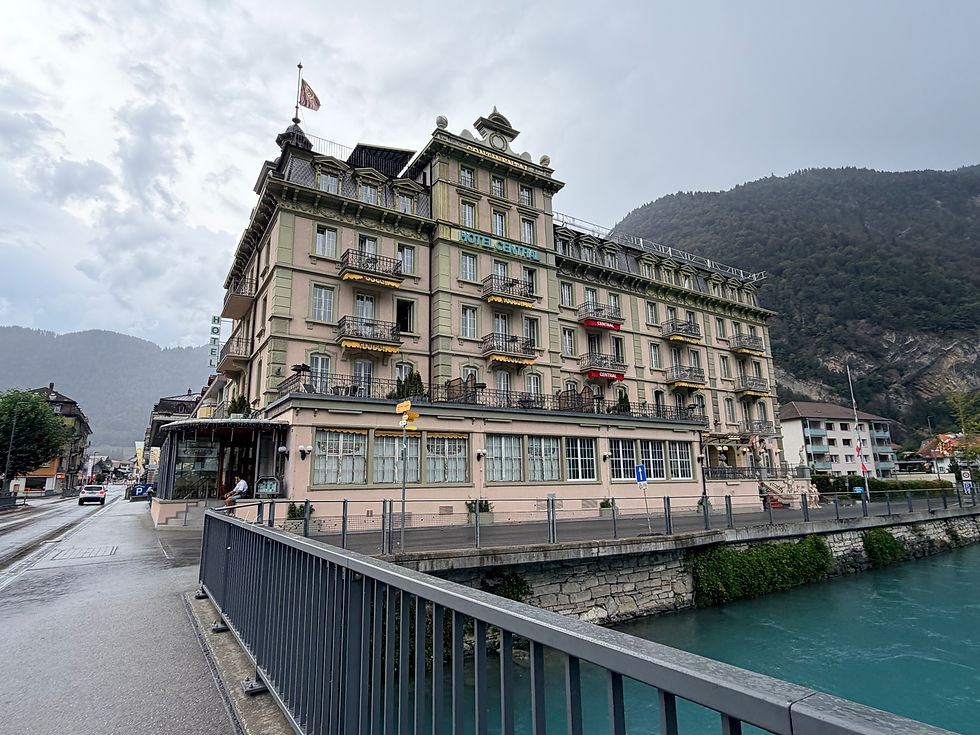
Water defines Interlaken, Switzerland. Nestled between the turquoise Lake Thun and Lake Brienz and connected by the rushing Aare River, the town sits on a valley plain carved by ancient glaciers. This glacial melt carries rock flour that gives the water its striking color, shaping the region's geography, local life, and identity.
"Geographic Role
Between Two Lakes: Interlaken lies on a flat alluvial plain formed completely by waterborne sediment between Lake Thun and Lake Brienz.
The Aare River: Flows right through the center, linking the energy of Interlaken with the historic charm of Unterseen.
Glacial Origins: Surrounding peaks feed the waterways with pure alpine melt, rich in suspended microscopic stone dust that creates the distinct bright turquoise shade."
Cultural and Daily Importance
Life Force: Local drinking water relies heavily on pristine natural underground reserves and mountain springs.
Recreation: The clean rivers and lakes serve as natural playgrounds for swimming, boating, and tourism.
The Slogan: The phrase "water is the basis of existence" reflects how deeply the community values and protects this fragile alpine ecosystem.


Comments