
Zig Zagging Across Lake Thun

The activity of the day was to take the boat cruise on Lake Thun. Decided to take the train first to Thun, walk around the town since we had time to spare before the cruise, and then take the boat back to Interlaken.
As we had some time, we toured a small portion of Thun.


The historic city center is not located directly on Lake Thun, but about 1.5 kilometers away on the Aare. The city center consists of the Schlossberg, the Unterstadt, the upper main street and the Bälliz. On the Schlossberg are the castle and the city church.
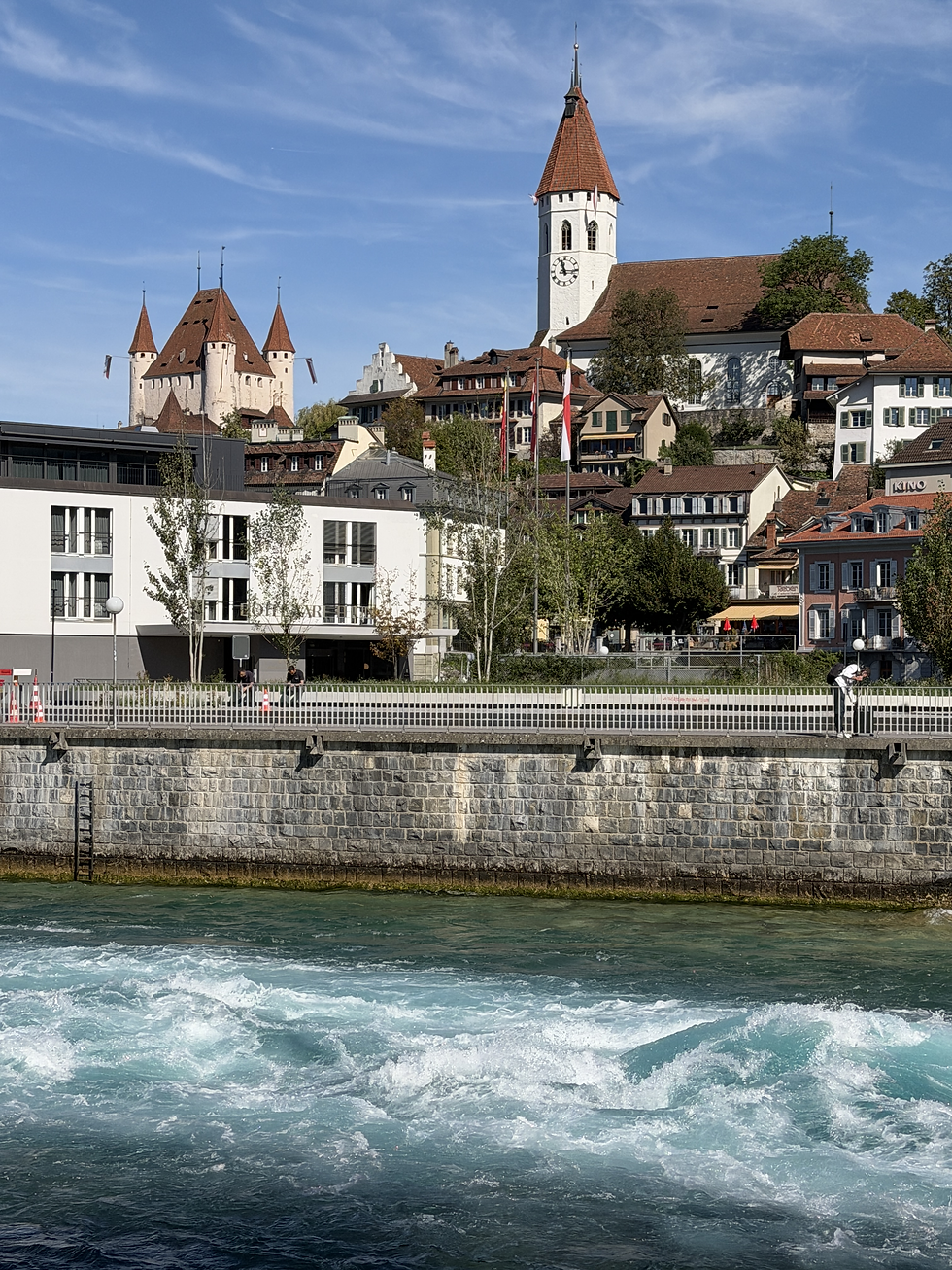

"In the 1830s, the construction of hotels and guesthouses began in Thun, so with the hotels Falcons 1835, Bellevue with Landtehaus and Du Parc 1831-40. Around 1825, the Pension Baumgarten opened (from 1899 Hotel Baumgarten-Viktoria), in 1839 the Pension Bellerive and in 1858 the Pension Itten. A second wave of construction stalled because of the economic crisis of the 1870s: Although the Seefeld was opened up from 1870, the tourist district, which was planned in 1862, did not materialize. Instead, villas were built there."
"In the Hofstettenquartier, at the site of today's Thunerhof, there were the oldest industrial enterprises in Thun: the brick factories. They were already mentioned in a document in 1437. They worked with clay from the Seefeld and Steffisburg. The wood for burning came on the waterway, mostly from the Simmental. The brickworks were moved to Steffisburg in 1869. In the same year, the members of the “United Family Estate”, which emerged from the former alpine and all-mend corporations, decided to dissolve and dedicate themselves to Thun tourism as a public limited company under the motto «lifting of Thun as a foreign place» with a luxury hotel unprecedented for Thun conditions at that time. The AG had a considerable fortune, not least from the sale of the Thuner Allmend to the federal government as part of the Swiss Waffenplatz. The Thunerhof was opened in June 1875 after about two years of construction according to plans by Adolphe Tièche from Bern. It is a powerful, clearly structured hotel building in French New Renaissance forms with a dominant tower. Also worth seeing is the staircase with the galleries and the light shaft inside the building."
"The company was the largest and most luxurious hotel in the Bernese Oberland to date. Business went badly from the start. During the construction of the Thunerhof, the construction budget was massively exceeded, and in addition, the first years of operation brought unsatisfactory results and frequencies, since the hotel in Switzerland and Europe was not or only barely known. In addition, in the first period, it was headed by an incapable director who was dismissed and that interest burdens were squeezed by large bonds which had to be taken out. As far as food, room and service were concerned, there was a lot of praise to be heard, the relatively high prices, on the other hand, made many guests deter. These were the main reasons that led to the first years of the Hotel Thunerhof being under a little hopeful star. The desperate financial situation in which the building society soon found itself, led to the fact that the municipality had to take over the Thunerhof in 1878. The building society was subsequently dissolved. Thus, the city of Thun had become a hotel owner, which she was to remain until 1895."
"1895 was a real fate year for the Hotel Thunerhof, decided on October 27, 1895 the meeting of the municipality of Thun after long negotiations the Thunerhof to the Company Hotels Thunerhof and Bellevue Thun to sell. The following years from the turn of the century to the outbreak of the First World War were undisputed The Golden Years in which the hotels flourished and beautiful yields could be generated. In 1896, the company belonged to the joint stock company Kursaal Open.
With the outbreak of the First World War in 1914, the heyday of the three hotels – and in particular of the Thunerhof – was abruptly interrupted. In isolated seasons both in the years of the First World War and in the 20s and 30s, the Thunerhof was not opened in the first place, as the foreign guests stayed away. The longer the Thunerhof-AG fell into a desperate financial situation, which was tried to counter with various renovations, but always only with very moderate success. Bills from the light and waterworks could only be paid laboriously. The Second World War and the economic crisis then caused the definitive end of the hotel operation in the Thunerhof, while the Bellevue was still open to tourists until 1980. The building was occupied by the military and later used as a soup kitchen."
"History was repeated in 1942 and on the 3rd of May approved the purchase of the Thunerhof, Bellevue and Du Parc properties with a change through the city of Thun. Since 1942, the Thunerhof has been an administrative seat of the municipality of Thun. The Thun Art Museum has been located on the ground floor since 1948."


The Fulehung is a traditional masked jester figure who appears annually during the "Thuner Ausschiesset" folk festival in Thun,
Origin and Legend
Burgundian Wars: The tradition dates back to 1476 after the Battle of Murten.
Charles the Bold: Troops from Thun captured the court jester of the Burgundian duke Charles the Bold, who had mocked local soldiers as lazy.
Name Evolution: Formerly known as "Bajass," the figure later took the name Fulehung (derived from fauler Hund, meaning lazy dog).
The Event and Appearance
When: He appears early in the morning at 5:00 AM on the Monday of the autumn festival.
Costume: He wears a two-toned beige outfit trimmed with bells and a horned devil mask.
Actions: Armed with a wooden log (Schyt) and inflated pig bladders (Söiblattere), he chases crowds through the old town of Thun.
Treats: Despite his rough appearance, he hands out sweets and carousel tickets to children.
I have attended a few ago and I grabbed for the treats, too. I liked the large chocolate piece the size of a 5 CHF in gold wrapping.
Children and adults keep chanting: Fulehung, Fulehung.... until he chases you.
Good luck comes to you if you are hit with the balloons. Pig bladders have been changed out to balloons.

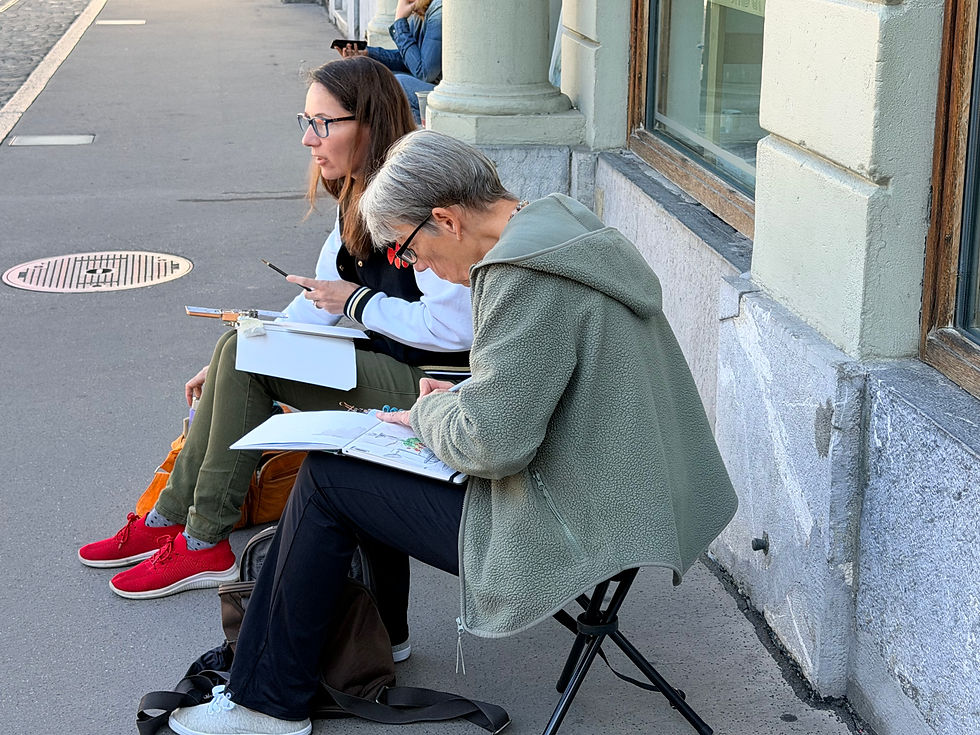
People were sketching the buildings around Rathaus Square. Some people were adding water colors, too.


Eyes Up!

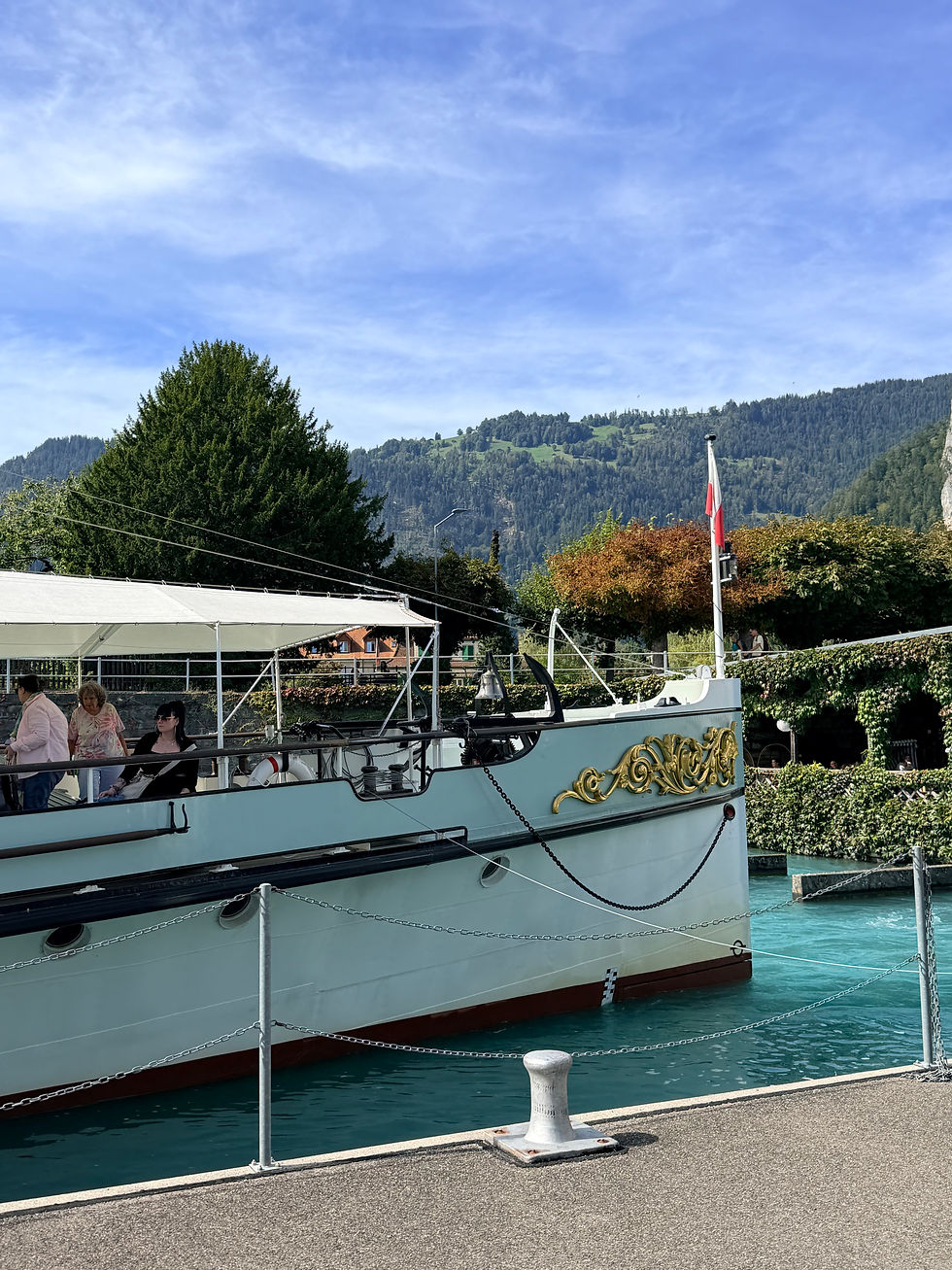
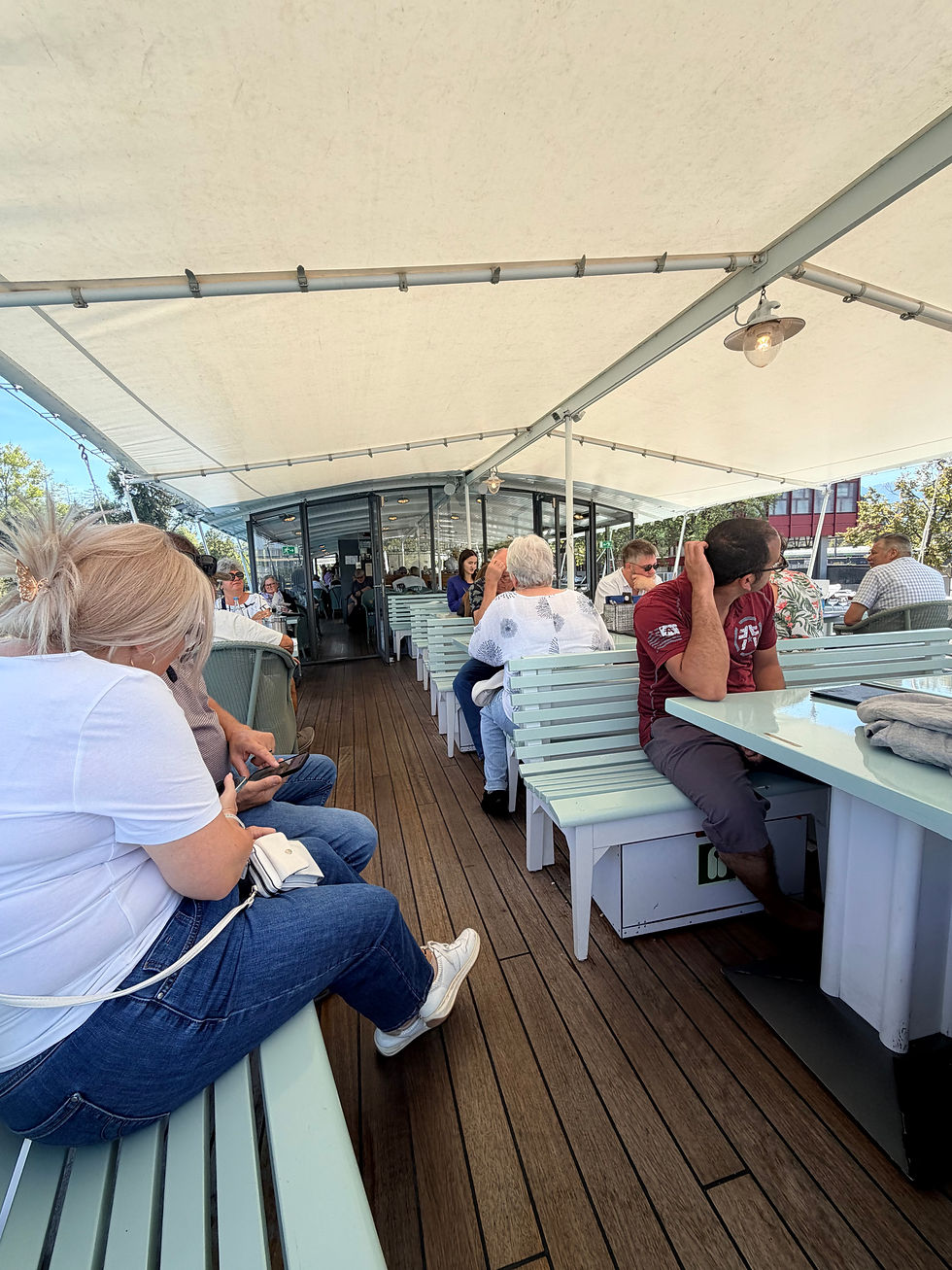
We took the paddle boat from Thun to Interlaken West.





"Schadau Castle has a history dating back to 1348, when the House of Schadau was first mentioned in writing. The 3.6-hectare Schadau Park has been open to the public since 1860 and is designed in the style of an English garden.The castle's location directly on Lake Thun and at the outflow of the Aare River is unique as it is associated with the Scherzlig Church, one of the thousand-year-old churches on Lake Thun. The construction of the current castle building was commissioned by the Neuchâtel banker Denis Alfred de Rougemont between 1847 and 1852. James Victor Colin, so from Neuchâtel, and the architect Pierre-Charles Dusillion, trained at the École des Beaux-Arts in Paris, created a building that testifies to the highest engineering, from its rich sandstone ornamentation to exquisite interior furnishings. As one of the most important works of Romantic Historicism in Switzerland, Schadau Castle represents a cultural asset of national importance. In the castle's entrance hall, a sandstone staircase designed by the sculptor Joseph Hubert Verbunt leads to the upper floors. and Throughout the building are outstanding wood, marble, and stucco imitations. Since 1925, the castle and park have been owned by the city of Thun, and a restaurant occupied has the ground floor since 1928. After various mixed uses, Schadau Castle was converted into a fully integrated restaurant and hotel between 2017to its finish in 2019. During this renovation, a building history survey confirmed that virtually all of the original interior fittings have been preserved. This includes wooden elements such as windows, niche paneling, doors, wainscoting, and flooring, as well as covered wood that was beneath many layers of paint. Schadau Castle was built as a private summer residence. It has always been a social hub on the lake and is now open to all visitors as an immersive and habitable work of art.


Scenery along the way


"In 1200, a daughter of the family von Oberhofen, Ita, married into the von Eschenbach family and gave the castle and village to her new family. In the 13th century the family began a new, moated castle on the shores of Lake Thun. In 1306, the von Eschenbach family was forced to sell Oberhofen and the castle to the Habsburgs. The Habsburgs appointed a succession of vassals to administer the area for them, especially the Kyburgs who also owned Thun Castle. Following the Kyburg defeat in the Burgdorferkrieg of 1383-84 and the decisive Habsburg defeat at the Battle of Sempach in 1386, Bern began to expand into the Austrian lands in the Bernese Oberland. They occupied Oberhofen in 1386 and were finally able to purchase or usurp all the land and rights from every feudal land holder in 1397. In the following year they sold the castle and Oberhofen Herrschaft to Ludwig von Seftigen, a citizen of Bern."


"Over the following centuries the town, castle and herrschaft passed through several Bernese patrician families. After the male line of the von Erlach family in Oberhofen died out, Bern acquired the castle and lands. They created the bailiwick of Oberhofen and converted Oberhofen Castle into the administrative center for the bailiwick. Following the 1798 French invasion, Oberhofen am Thunersee became part of the Helvetic Republic Canton of Oberland. After the collapse of the Republic and 1803 Act of Mediation it joined the newly created Thun District."


"Traditionally vineyards and wine production were an important part of the local economy and grapes appear on the municipal coat of arms. In the 19th century, the vineyards went into decline due to increased supply from other wine growing regions and problems with disease. In 1881 there were 18 hectares (44 acres) of vineyards, but by 1900 it was only 4 hectares (9.9 acres) and by 1911 there were no vineyards in the municipality. Decreasing viticulture and limited farm land led to constant emigration, generally to North America, throughout much of the 19th century. In 1936 a few small vineyards were replanted on the sunny terraces above Lake Thun. In 2008 there were a total of only 2.88 hectares (7.1 acres) under viticulture in the municipality."
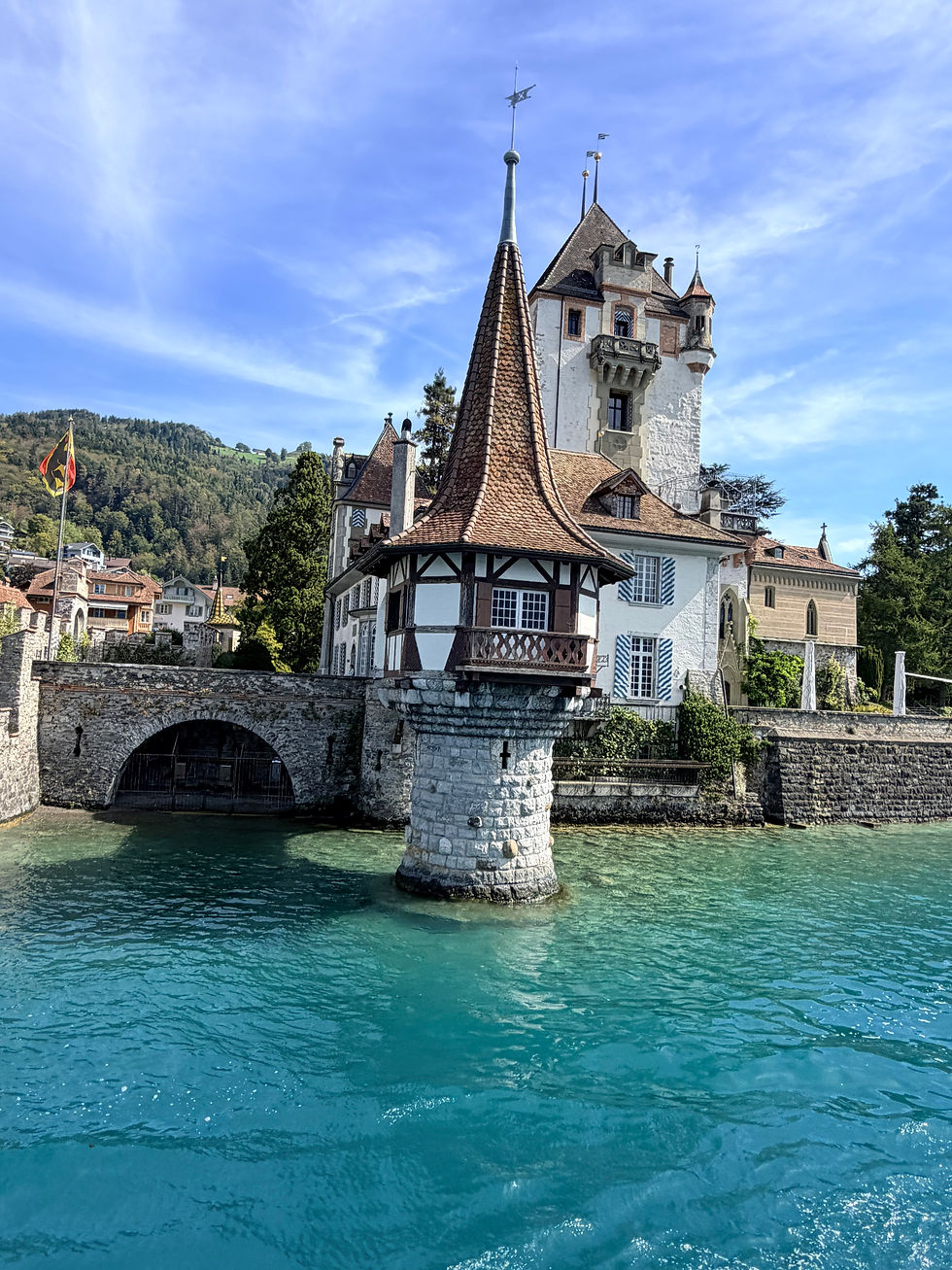
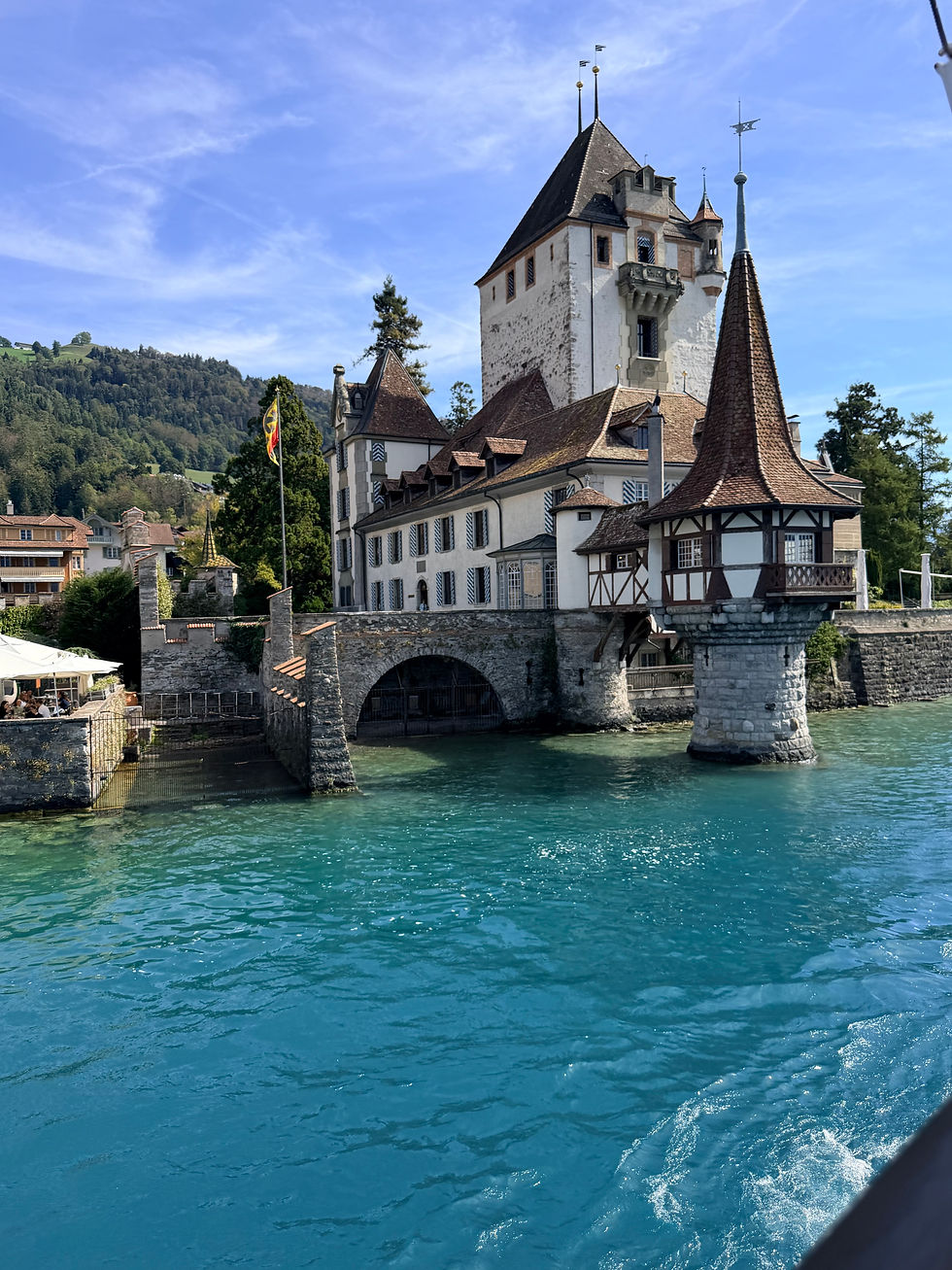
In 1864 a fire destroyed part of the town, but opened up land for new developments. In the following decade the municipality grew into a health spa destination and in 1875 the Logierhaus Moy (Moy Hotel) opened. It was followed by several other hotels, resorts and spas over the following decades. The Seestrasse, a road along the lake, was completed in 1884 and helped bring tourists to the town. The Seestrasse was followed by the Steffisburg-Thun tram in 1913 which made visiting Oberhofen even easier. However, the outbreak of World War I devastated the tourist industry. In the interwar period, tourism returned slightly but not to the levels that it had seen before the war. A new dock was built in the lake for tour boats, but other new construction remained limited. Tourism slumped again with the outbreak of World War II and did not recover until 1950. Beginning in the 1950 many new vacation homes and a beach promenade were built to bring tourists back to the municipality. A regional indoor pool opened in Oberhofen in 1970. Today, a number of small businesses operate in the municipality, but about two-thirds of the labor force commutes to jobs in cities like Thun and Bern.


"The castle passed into private hands after 1803 and had several owners in the following years. In 1849-52 the Pourtalès family renovated and expanded the castle to its present appearance. In 1940, the American William Maul Measy established the Oberhofen Castle foundation to administer and maintain the castle. In 1952 it became a part of the Historical Museum of Bern and two years later they opened a branch in the castle."
"Oberhofen has always been a part of the parish of Hilterfingen and the parish church of St. Andrew is actually within the Oberhofen municipal borders. In 1834 Hilterfingen and Oberhofen separated into two independent citizen's communities but remained part of a common parish."

The Panorama Bridge Sigriswil is a 340-meters (1115.49 feet) long pedestrian suspension bridge that hangs 182 meters (597 feet) above the deep Gummischlucht Gorge.

Key Facts
Dimensions: 340 meters long and 182 meters high above the canyon floor.
Location: Connects the villages of Sigriswil and Aeschlen in the Canton of Bern.
Views: Offers views of Lake Thun and Bernese Alps peaks like the Eiger, Mönch, and Jungfrau.
Fame: Featured in the hit Korean drama series Crash Landing on You.
Cost: Crossing the bridge costs 8 CHF for adults (discounts apply with local visitor cards or regional passes), which goes toward maintenance. Children under 16 enter free.
Accessibility: Open year-round and accessible for strollers, wheelchairs, and dogs.

In Crash Landing On You, episodes 4, 12, and 16, the bridge serves as an emotional turning point where Ri Jeong-hyeok unknowingly saves Yoon Se-ri from jumping, and where they later cross paths and reflect on their fated connection.

The imposing panoramic suspension bridge in Sigriswil is considered a masterpiece of engineering. With a span of 340 meters and a height of 180 meters, it is one of the longest pedestrian suspension bridges in the world. Whether you are a hiker, jogger, cyclist, in a wheelchair, in a group or as a family with children, with or without a dog - everyone can enjoy the

The Sigriswil Bridge or the Panoramabrücke Sigriswil is the place where Ri Jeong-hyeok unknowingly saves Yoon Se-ri‘s life for the first time when he asks her to take a picture of him and his fiancée as she is about to jump. This scene, in fact, featured in episode 4.


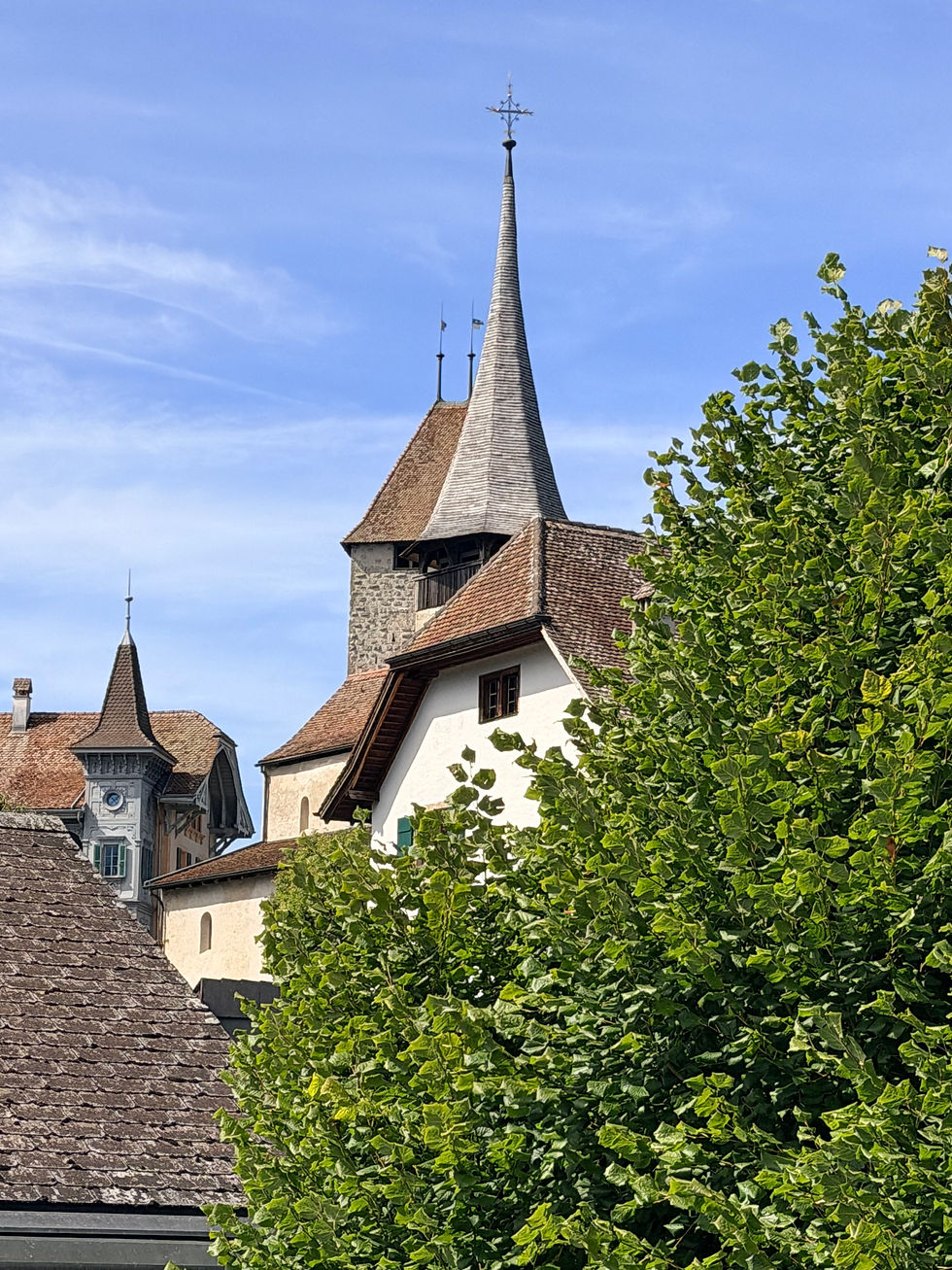
Coming into Spiez
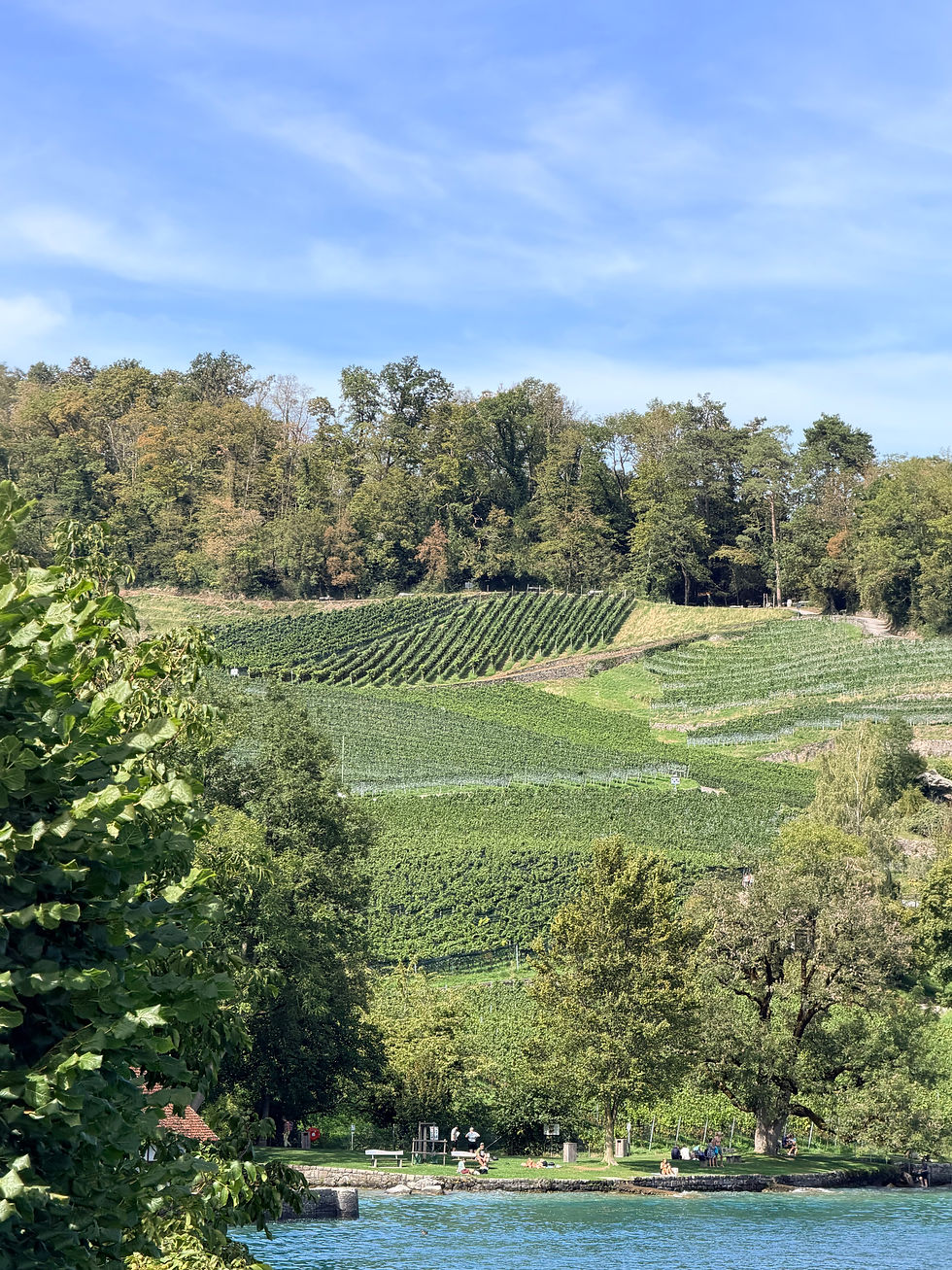
Spiez extends from an altitude of 558 meters (1831 feet) above sea level (lake level) to 852 (2795 feet) m above sea level (Hondrich Hill).
"Spietz's balanced climate, the right variety of vines as well as the warm southern wind called «Föhn» allow Spiezer to produce beautiful, fresh, lively Spiezer white wines The reds are known for their sophistication, and elegant fruity flavors."


Spiez has one of the vineyards highest north of the Alps, where "Spiezer Wein" is produced. They have excellent white wine that is a favorite of ours.


Justistal: A famous, picturesque high mountain valley. It is well-known for its beautiful hiking, cross-country skiing, and the traditional autumn Chästeilet (cheese-sharing festival). The "Chästeilet" cheese apportioning ceremony has been a tradition of the Justistal every September since 1739. In this time-honored ceremony, Swiss cheese produced over the alpine summer from the milk of 250 cows is divided according to a prescribed ritual.
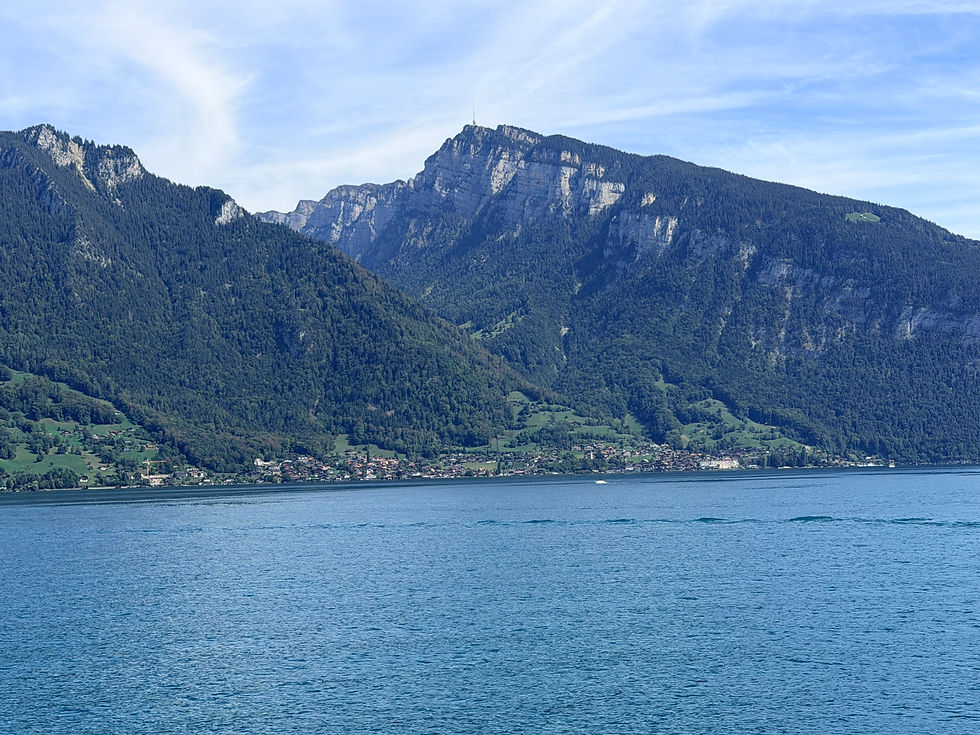
The St. Beatus caves are among the largest developed caves in Switzerland. They are spectacularly located above Lake Thun. About one kilometer of the gigantic cave system is accessible and magically illuminated. The temperature in the mountain is between eight and ten degrees Celsius with high humidity. The cave path is not barrier-free.


Coming from the lake into the channel.

Trees are dying but they are a pretty Fall color.

In year's past, Michael and I used to sit on this bench and have a picnic lunch and watch the boats come in and out of the channel.

Went to the Luegibrüggli for dinner.

Adventure Guesthouse






Bennett started with escargots

Michael and I had the chateaubriand. To cook a classic Chateaubriand, sear a 2-pound center-cut beef tenderloin in a hot pan, roast it in the oven at 325°F–375°F until the internal temperature reaches 125°F–130°F for medium-rare, and let it rest before slicing.


Michael and I had the chateaubriand

Bernaise, garlic butter, morel sauce

Bennett had the lamb

Sharon had hacksteak stroganoff and risotto

Bennett had the coupe Danmark for dessert


Comments