
How Young Is Your Cheese??

The Chästeilet Wengen is Wengen's traditional annual cheese festival celebrating the end of the alpine summer. It is held the last weekend in September. The festival is held at the Wengen Ice Rink (Eisfeld), located in the car-free mountain village.
This is the second year Michael and I have participated in the cheese share. I was the one who choose our wheel of cheese. I wanted one from Wengen and I also wanted one with a little darker color this year since it means it is a little older. The lighter the color the younger the cheese.
You must arrive to the festival early to find your perfect wheel of cheese. The festival started at ten and by noon your choices were limited and as you can see, the bottom shelf was empty.
The traditional dividend distribution of cheese shares to "cow share" investors was held today.
What is a cheese share?
A cheese share is a great way to experience the Swiss Alps and their traditions, enjoy delicious cheese and do something good for local agriculture at the same time.
What does that mean exactly?
When you buy a cheese share, you are essentially supporting local agriculture and the alpine cheese dairy. You become part of the "cheese family", so to speak. In return for your investment, you receive a portion of the cheese that the cows have produced over the summer at the Chästeilet. This is not only delicious, but also a great way to get to know the nature and traditions of the region.
What is included in the cheese share?
Cheese (Käse) Naturally, the main part of your reward is the cheese produced by the cows. Depending on the type of share, you receive either a whole wheel of mountain cheese weighing 6–7 kg or a Mutschli (a smaller round cheese) weighing 1–1.5 kg. Our cheeses come from Wengernalp (Katrin Wüthrich), Allmend (Fred Ameter), and Spätenenalp (Adrian Rubin). During the alpine summer season, you have the opportunity to visit the cheese makers, watch the production of "your" cheese, and perhaps even lend a hand.
A dry sausage
A surprise: There is also a little surprise. Something boiled down, honey, liqueur, pocket knife... Last year I received a beautiful cutting board and this year it was a bound note pad and pen.
Invitation to the Chästeilet: As a cheese shareholder, you are of course invited to the big party where you can pick up your cheese and enjoy the festive atmosphere.
Why should you buy a cheese share?
Supporting local agriculture: By buying a cheese share, you help the farmers and contribute to the preservation of traditional alpine cheese dairies.
Delicious cheese: You get high-quality, excellent cheese directly from the producer.
Unique experience: The Chästeilet is an unforgettable experience
Original gift: A unique gift for yourself
How did it all begin?
The Chästeilet is not a new idea. For centuries, the mountain and alpine cheeses have been divided up among the cow owners at the end of the alpine summer. This tradition exists throughout Switzerland, and the best known takes place in the Justistal Valley.
In 1999, a group of chefs from Wengen had the idea that a Chästeilet would also be a good idea for Wengen. In Wengen, however, cheese sharing is not celebrated as elaborately as in the Justistal. It all started with the first cheeses from Melanie the cow on the Wengernalp. Later, they also needed Melanie's colleagues to produce enough dividends. We still commemorate Melanie today by "committing" the shareholder to include Melanie in his evening prayers.

Coordinates the cheese sharing.

Created in 1999, it gives local alpine farmers a dedicated marketplace to sell their seasonal alpine cheese, growing into Wengen's second-largest annual event after the Lauberhorn ski races.


The festival is hoping to welcome between 1000 and 1300 visitors this year.
All the tables inside the tent were full and there was a crowd of people outside enjoying the sunshine.


The barbecue is still there, but the range has been expanded to include rösti, roast veal, raclette and other delicacies from Wengen's hotels and restaurants.


I enjoy my raclette with pepper, pickled onions, and gherkins.


The soup is usually pumpkin soup but today it was mushroom. Michael doesn't care for mushrooms even though he does eat them on occasion. This one had tiny pieces of mushrooms and carrots. He actually liked it.


There is also a separate bar area.

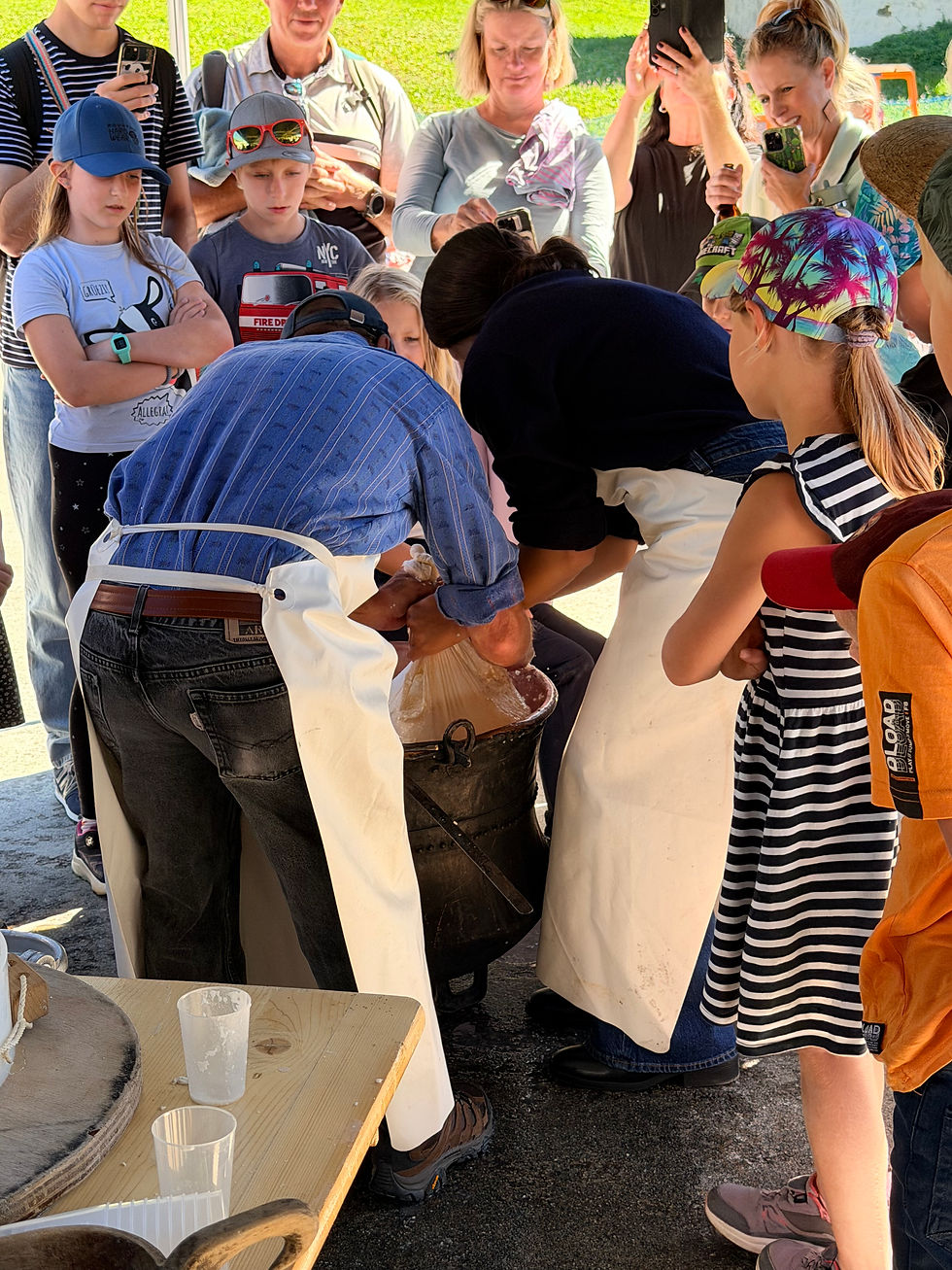
In addition there is a gourmet market (Genussmärit) and a live cheese-making demonstration.
He allowed the children standing near the kettle to stir the milk.




There are alphorn performances, the Wengen community band, traditional dance group of Wengen, folklore music, bell ringers, and a stone-throwing competition.


The dog seemed to like the music. People were clapping and singing along.


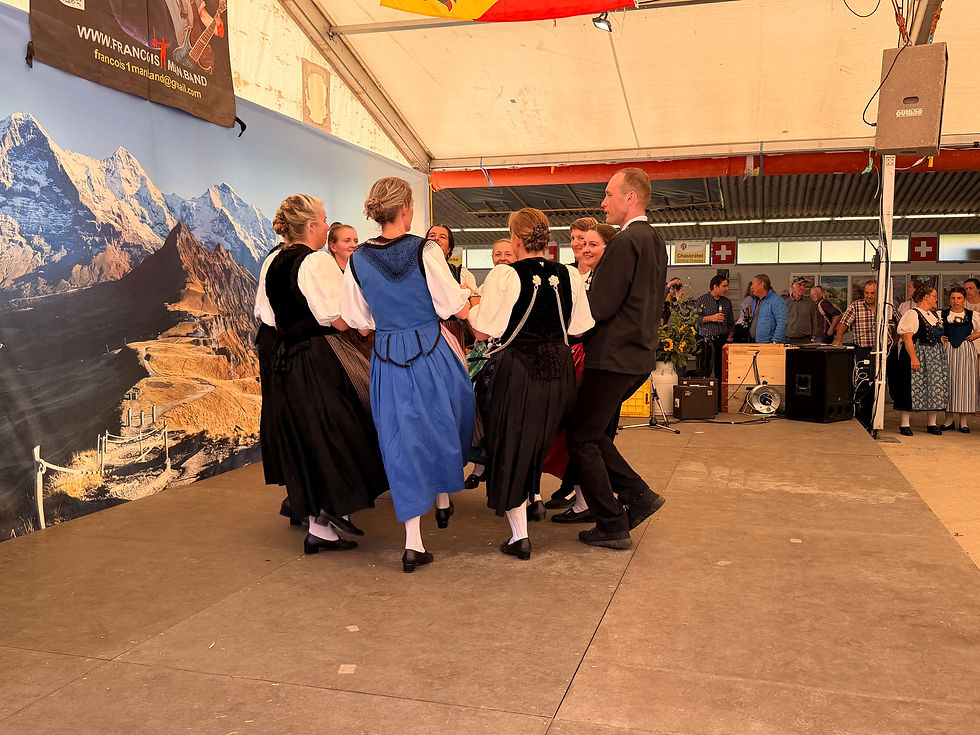


There was an explanation and discussion of the different dresses from different regions. Many of the traditional clothing is handed down from one generation to the next.
Tracht: This traditional folk costume varies significantly across Switzerland's 26 cantons and individual regions, with hundreds of distinct local styles featuring unique embroidery, colors, and accessories.
Today, these outfits are no longer worn for daily wear, but are reserved for cultural events, folk festivals, music gatherings, and Swiss National Day.
The traditional folk dress worn by women in the Berner Oberland and the wider canton of Bern is called the Tracht (specifically the Berner Tracht or Bernese folk dress).
"
Key Features of the Berner Tracht
The Gown and Skirt: Locals refer to the main piece as a gown rather than just a skirt, often paired with a vibrant-colored apron (such as bright blue, red, or green striped designs).
The Bodice and Blouse: It features a crisp white blouse underneath a close-fitting, often embroidered bodice or vest.
Accessories: Traditional elements include a delicate filigree brooch on the blouse and a distinctive black silk neckband."


This dress is from the Grindelwald area.


Traditional music in the Bernese Oberland centers on yodeling, alphorn playing, and Schwyzerörgeli (Swiss accordion) folk dance music.
Key Styles of Traditional Music
Naturjodel (Natural Yodel): Wordless, melodic yodeling tunes sung in harmony, often echoing across mountain valleys.
Alphorn Melodies: Deep, resonant calls and tunes played on the traditional long wooden alphorn.
Ländler and Volksmusik: Lively dance tunes featuring the Schwyzerörgeli (diatonic button accordion), fiddle, and bass, played in styles like polkas, waltzes, and schottisches.
Regional Folk Songs: Traditional vocal pieces about mountain life, love, and local identity, such as the famous regional anthem "Vogellisi".
When and Where It Is Performed
Alpine Festivals: Celebrated during seasonal traditions like the Chästeilet (the autumn ceremonial cheese-sharing and cattle descent from the high pastures).
Local Concerts: Featured at summer folk music events and cultural series held across the region, including Interlaken and nearby alpine villages.


Iconic Swiss Instruments
Alphorn: The most famous Swiss national instrument, this long wooden natural horn (ranging from 3 to 4 meters) was historically used by shepherds to communicate across mountain valleys. It has no valves or finger holes, meaning notes are produced entirely through breath control and lip tension.
Schwyzerörgeli (Schwyz Accordion): A compact, lightweight diatonic button accordion that is easy to transport. It remains a core component of traditional folk dance music, such as Ländler and polkas.
Büchel: A shorter, bugle-shaped cousin of the alphorn that is held like a trumpet. It produces a clearer tone but is notoriously difficult to master.
Hackbrett: A type of hammered dulcimer played with two small wooden hammers. Popular in Appenzell and Valais, its strings are struck rather than plucked.
Hexenscheit (Witch's Board): A trapezoidal Bernese zither with a metallic sound, traditionally played on the lap or a table using the fingers.
Talerschwingen: An unusual folk tradition rather than a standard manufactured instrument, where a five-franc coin is rhythmically rolled inside a large ceramic bowl to mimic the deep sound of cowbells.
The Swiss bell ringers of the Berner Oberland (Bernese Oberland) are part of a deeply rooted Alpine tradition known as Trycheln or Schellen. Rather than ringing church bells, these groups consist of local men, boys, and women who march in a synchronized, rhythmic waddle while swaying massive, heavy cowbells.


The mistress of ceremony. She does a wonderful job introducing people, etc.

She was announcing the participants for the steinstossen. She is qutie a confident woman.

The finals of the steinstossen


First place was a whole cheese. Second place was half a cheese. Third place was a quarter.

For the men, the winner was from California.


Comments