
Graduation Practice

Sion is a city in the southwestern Swiss canton of Valais. It’s known for 2 hilltop fortifications: the 13th-century Tourbillon Castle ruins and the Valère Castle complex, with a basilica housing an organ over 500 years old. The 15th-century Cathedral of Notre-Dame-du-Glarier and the conical Witches’ Tower are in the old town. The Majorie and Vidomnat towers house the Valais Art Museum’s regional art collection.
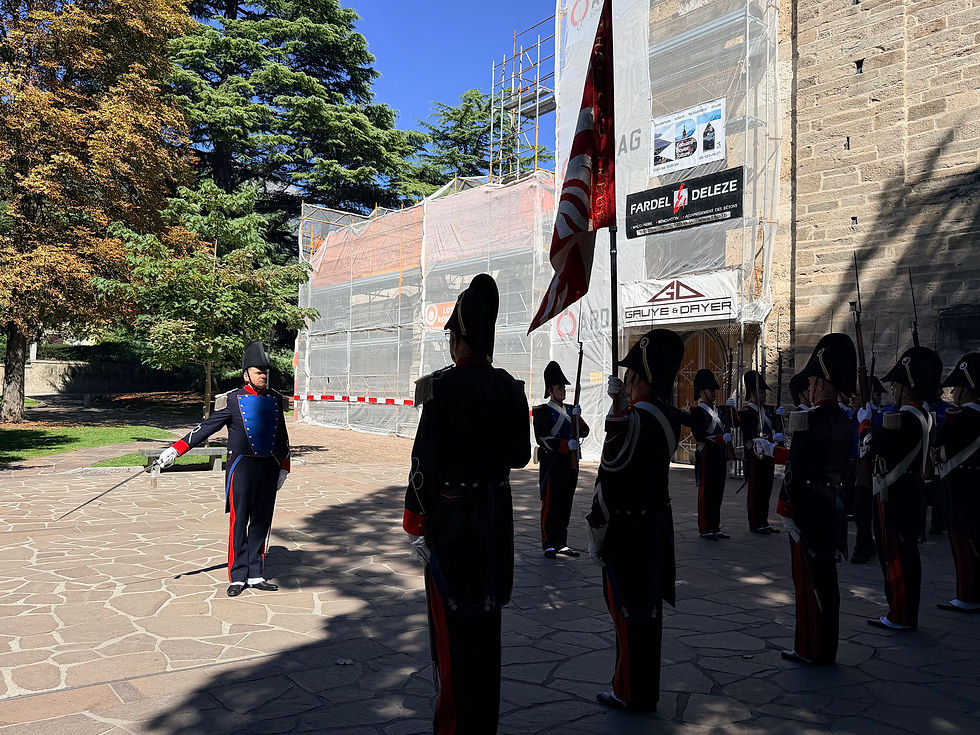
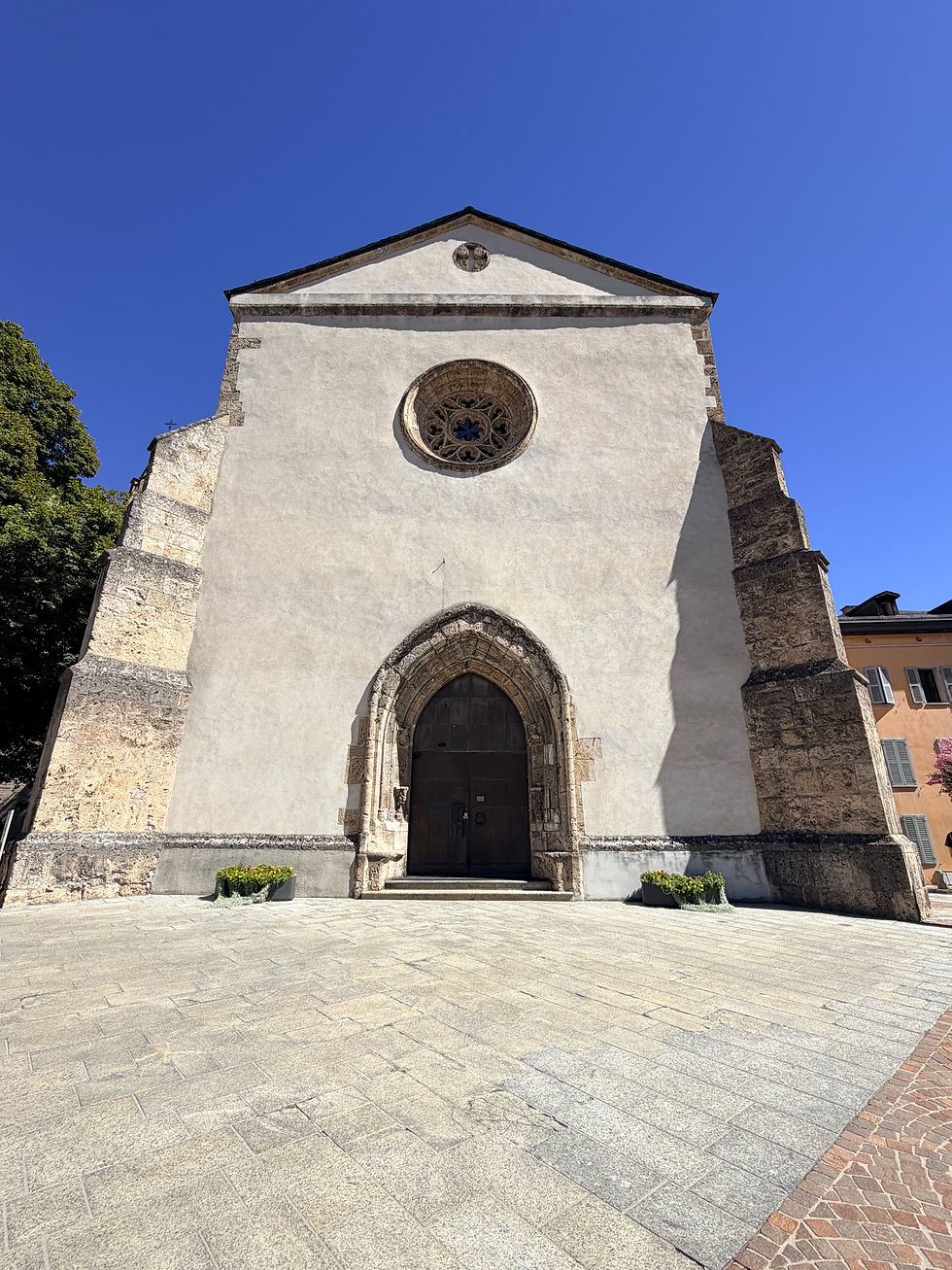
Today we witnessed practice for a police graduation at the Sion Cathedral or the Cathedral of Our Lady of Sion (Cathédrale Notre-Dame de Sion, Cathédrale Notre-Dame du Glarier) is the Roman Catholic cathedral in Sion, Valais.. It is the seat of the Diocese of Sion.
There is much pomp and circumstance when it comes to this ceremony. This ceremony certainly is a grand, formal, and flashy ceremony and a public display filled with rich traditions, decorations, and celebration.


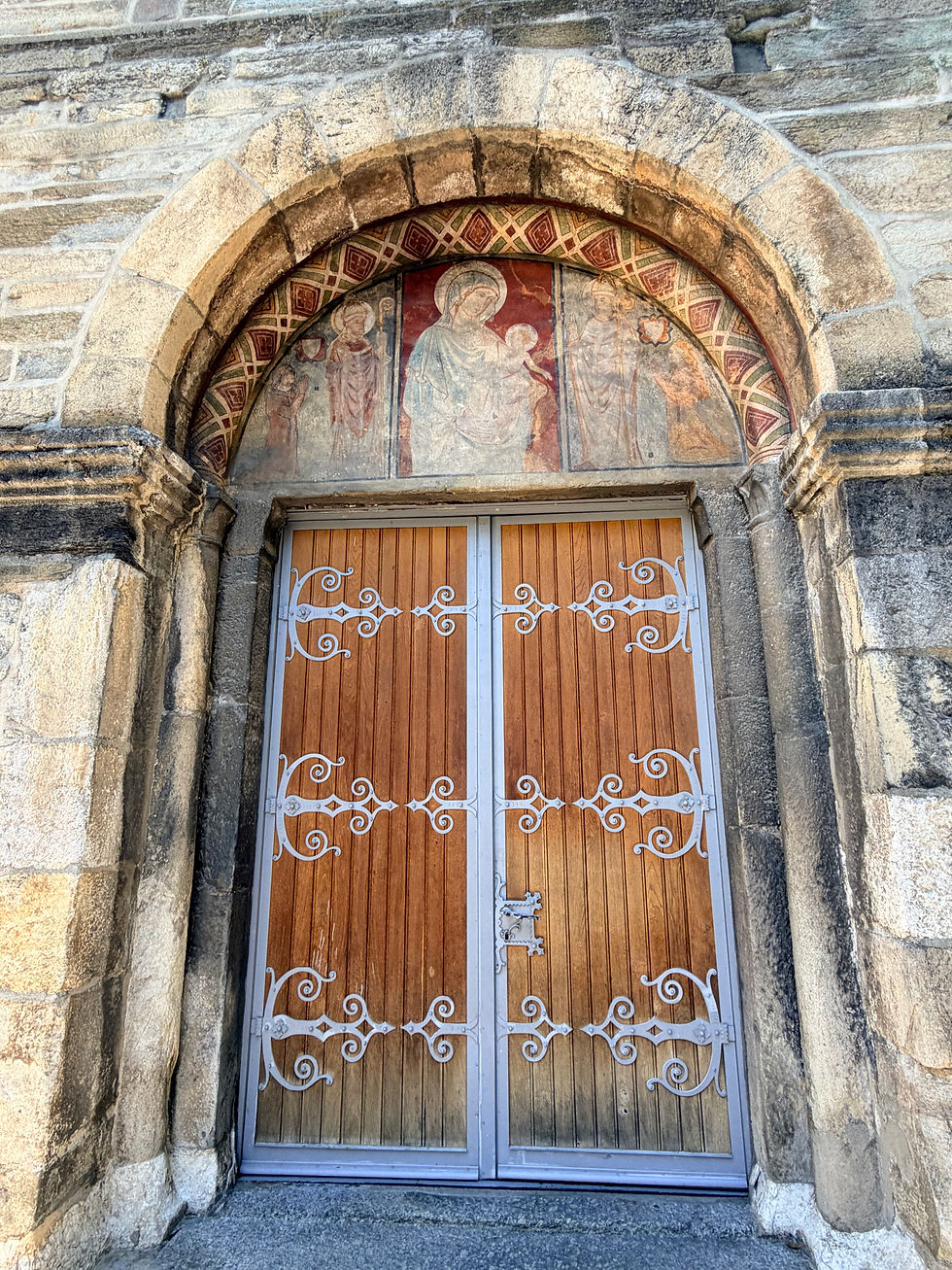


At the entrance of the cathedral.


The Valais area is known for growing grapes for wine.


The crypt


We had seen the chairs set up but we didn't know the reason why.Then, we saw the police band walk into thew cathedral.


Rehearsal
Graduation marching into the cathedral practice.


Sion is a town situated in the Rhône Valley, a municipality, and the capital of the canton of Valais and of the district of Sion. As of December 2020 it had a population of 34,978.
"Sion is one of the most important prehistoric sites in Europe. The alluvial fan of the river Sionne, the rocky slopes above the river and, to a lesser extent, Valeria and Tourbillon hills have been settled nearly continuously since antiquity. The oldest trace of human settlement comes from 6200 BC during the late Mesolithic. Around 5800 BC early Neolithic farmers from the Mediterranean settled in Sion. The settlements remained small until about 4500 BC, during the middle Neolithic, when the number of settlements increased sharply. To support the population increase, farming and grazing spread throughout the valley. They also began burying their dead in Chablandes-type stone burial cists with engraved anthropomorphic stelae."
A burial cist is a small, stone-built, box-like coffin or grave used in ancient times to hold human remains.
"Key Features of Burial Cists
Construction: Four upright flat stone slabs form the sides, often with a bottom slab and a large flat stone called a capstone on top.
Size: They are usually small and built to hold a single body—frequently placed in a crouched or flexed position—or used for cremations.
Time Period: They are most commonly associated with the Bronze Age (roughly 2500–1500 BCE), though they also appear in Neolithic and early medieval times.
Location: Cists were often buried underground, sometimes placed beneath a mound of earth or a stone pile known as a cairn.
Grave Goods: Excavations of cists frequently reveal pottery, flint tools, or personal ornaments that show the status of the buried person."
Stelae
Stelae (plural of stele or stela) are tall, upright stone or wooden slabs that were carved, inscribed, or painted in the ancient world to serve as monuments, grave markers, or official notices.
Common Uses in History
Commemoration and Funerals: Many acted as ancient tombstones or memorials to honor the dead or celebrate major battles.
Public Decrees and Laws: Civilizations used them to publish royal commands, government notices, or laws for the public.
Boundary Markers: Some were placed to mark borders, territory lines, or city limits.
"The individual graves changed at the beginning of the 3rd millennium BC in large, dry stone wall communal tombs (such as the Dolmen of Le Petit-Chasseur). During the Beaker culture period in the second half of the third Millennium, dolmens were built once again, but they were smaller and had no podium. Stelae continued to be carved, though these were rich with geometric patterns and sometimes built out of old dolmen. At the beginning of the Early Bronze Age (around 2300 BC) the last stelae were erected."
The early settlements have been well documented. There are huts from the Middle Neolithic period found near Le Petit Chasseur and under Ritz Avenue. Late Neolithic sites have been found at Bramois and the early Early Bronze Age site is at Le Petit Chasseur. The Middle Bronze Age, however, is poorly documented. From the subsequent epochs, the great necropolis of Don Bosco (the "aristocrat" tumulus of the Late Bronze Age and Iron Age) and the necropolis of Sous-le-Scex from the La Tène culture.
"At the end of the 1st century BC, Sion was the capital of the Seduni, one of the four Celtic tribes of the Valais. Julius Caesar mentions them as Nantuates Sedunos Veragrosque.They were conquered by the Romans in the 10s BC. By 8–7 BC, Emperor Augustus praised the tribe (civitas) of the Seduni with an inscription. The town-hall is said to contain several Roman inscriptions, one of which found at Sion commemorates the Roman presence: Civitas Sedunorum Patrono.[7] Under the Romans it was known as Sedunum."
"The Roman settlement stretched mainly from what is now St. Theodul, between the Sionne and to the west side of the hill, Valeria. Under the church, a large bath complex was discovered and partially excavated. Near La Sitterie, Sous-le-Scex and in the upper part of the Avenue du Petit Chasseur, portions of several villae suburbanae were found. In the 1st century AD, the Claudii Vallensium Forum, in what is now Martigny, became the capital of the civitas Vallensium. Sedunum lost political importance, but still remained the home of many notable families. Grave stelae attest to the presence of duumviri (magistrates of the civitas), of flamines (priests of the imperial cult), a Roman knight and a former consul in the town. In the 4th century praesides (provincial governors) are mentioned living in Sedunum, including a man named Pontius Asclepiodotus, who rebuilt an imperial building and, according to an inscription, converted to Christianity in 377."
"The Roman Catholic diocese of Sion is the oldest in Switzerland and one of the oldest north of the Alps. At first, the see was sited at Octodurum, now called Martigny/Martinach. The first authentically historical bishop was Saint Theodore or Theodolus (died 391), who was present at the Council of Aquileia in 381. He founded the Abbey of Saint-Maurice in Agaunum, with a small church in honor of Saint Maurice, martyred there c. 300, when he united the local hermits in a common life, thus beginning the Abbey of Saint-Maurice, the oldest north of the Alps. Theodore rebuilt the church at Sion, which had been destroyed by Emperor Maximinus at the beginning of the 4th century. At first the new diocese was a suffragan of the archdiocese of Vienne; later it became suffragan of Tarentaise."
"In 589 the bishop, St. Heliodorus, transferred the see to Sion, leaving the low-lying, flood-prone site of Octodurum, where the Drance joins the Rhône. Though frequently the early bishops were also the abbots of Saint-Maurice, the community of canons was jealously watchful that the bishops should not extend their jurisdiction over the abbey. Several of the bishops united both offices: Wilcharius (764–780), previously archbishop of Vienne, whence he had been driven by the Moors; Saint Alteus, who received from the pope a bull of exemption in favor of the abbey (780); Aimo II, son of Count Humbert I of Savoy, who entertained Leo IX at Saint-Maurice in 1049."
"The first cathedral probably dates from the 6th century. It was halfway up the hill, where later the church of St. Peter stood, until the 19th century when that church was demolished.The fortunes of the city grew when the bishop settled there. In 999, King Rodolphe III of Burgundy granted the entire County of Valais to the bishop, and Sion became the capital of this county. The prince-bishop had the rights of high and low justice, the right to his own regalia and to appoint his own vassals. The residents of Sion were ruled by three appointees of the bishop, the maior, the vice dominus or Viztum and the salterus."
There are 14 buildings or sites in Sion that are listed as Swiss heritage site of national significance. The secular buildings include the Archives de l’État du Valais, the Archives and Museum of the Bishop of Sion and the cathedral, the town hall (with its astronomical clock), Majorie Castle, La Majorie on Rue des Châteaux 19, Le Vidomnat on Place de la Majorie 15, the Maison Supersaxo, the Médiathèque Valais Sion, the Cantonal Fine Arts and History Museums and the ruins of Tourbillon Castle. The religious buildings on the list are the Cathédrale Notre-Dame, the Capuchin monastery and library, the church of the Notre-Dame de Valère and the church of St-Théodule. The remains of a Neolithic settlement and the modern city of Sion are also on the list. The entire town of Sion and the village of Bramois are both part of the Inventory of Swiss Heritage Sites.




1742


Jakobweg (Jacob's Way) Jacob's Way in Switzerland is known as the Via Jacobi, a historic 450 kilometer (280 miles) long-distance hiking and pilgrimage route stretching from Rorschach on Lake Constance to Geneva.

I wrote prayer intentions in the book.

Blessed Holy Water


I lit a candle. too.

A characteristic of Sion is its medieval townscape, dominated by the hills Valère (610 m (2,000 ft)) with the Basilique de Valère (12th–13th century), and Tourbillon (658 m (2,159 ft)) with the ruins of the Tourbillon Castle. The Valère Basilica is the church on top of the southern of the two mottes, at the east end of the old town. It houses the oldest playable organ in the world, which was built in the 1430s.t get the walking tour
It was market day in Old Town. The tourist information office is being remodeled so we couldn't get the walking tour map. Since this was our first ever visit to Sion, we will return another day.
Kimbap


Raclette


Vineyards as far as you can see


Quite a cheese shop


Something to explore next time. It was 87 degrees F (30.5 C) and very humid. Too hot to climb there.


Around one third of Swiss wine is produced by the vineyards of the Valais. The vineyards extend over 100 km (62 mikes) along the Rhône at between 270 meters (886 feet) and 1,100 meters (3608 feet) above sea level.
Many of the spectacular vineyards of the most important Swiss winegrowing region stretch in terraces along the upper Rhône River.
From Sion back to Visp you only see vineyards.


"The vineyards are spread along the right side of the river from Fully and Chamoson in the west, Conthey and Sion in central Valais and Salgesch heading east. The left side is dotted with smaller vineyards, between Lake Geneva, Martigny, Riddes and Siders. In Upper Valais, the vineyards go deep into the side valleys, with those at Visperterminen being some of the highest in Europe (also known as the Heida Village)."


Comments