
Can't Do Anything With My Hair!

Had quite a thunderstorm with hail around 2 A.M. Rain still coming down heavily when we got up a few hours later.
Walking in the rain isn't fun so I wasn't sure what I was going to do. Taking pictures of fog rising from the mountains doesn't make for an interesting blog entry.
Decided to do some grocery shopping instead of staying home, so off I went to Migros.
Luckily, I spotted the lady with the llamas by the bridge. By then, the rain had tapered off some, so I was able to photograph the llamas before the school group came.
These llamas are so curious and alert.


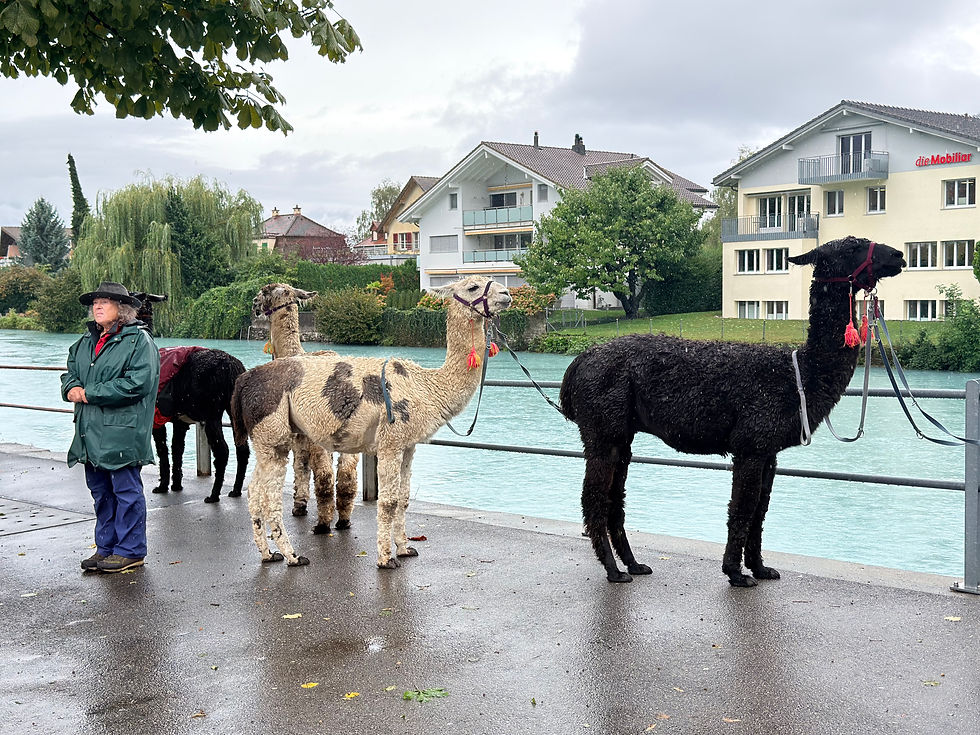
"Llamas are social animals and live with others as a herd. Their wool is soft and contains only a small amount of lanolin. Llamas can learn simple tasks after a few repetitions. When using a pack, they can carry about 25 to 30% of their body weight for 8 to 13 km (5–8 miles). The name llama (also historically spelled "lama" or "glama") was adopted by European settlers from native Peruvian Quechua."

"The ancestors of llamas are thought to have originated on the Great Plains of North America about 40 million years ago and subsequently migrated to South America about three million years ago during the Great American Interchange. By the end of the last ice age (10,000–12,000 years ago), camelids were extinct in North America. As of 2007, there were over seven million llamas and alpacas in South America. Some were imported to the United States and Canada late in the 20th century; their descendants now number more than 158,000 llamas and 100,000 alpacas."


"In Aymara mythology, llamas are important beings. The Heavenly Llama is said to drink water from the ocean and urinates as it rains. According to Aymara eschatology, llamas will return to the water springs and ponds where they come from at the end of time."
The Aymara or Aimara people are an Indigenous people in the Andes and Altiplano regions of South America. Approximately 2.3 million Aymara live in northwest Argentina, Bolivia, Chile, and Peru.
"A full-grown llama can reach a height of 1.7 to 1.8 m (5 ft 7 in to 5 ft 11 in) at the top of the head and can weigh between 130 and 272 kg (287 and 600 lb). At maturity, males can weigh 94.74 kg, while females can weigh 102.27 kg. At birth, a baby llama (called a cria) can weigh between 9 and 14 kg (20 and 31 lb). Llamas typically live for 15 to 25 years, with some individuals surviving 30 years or more.


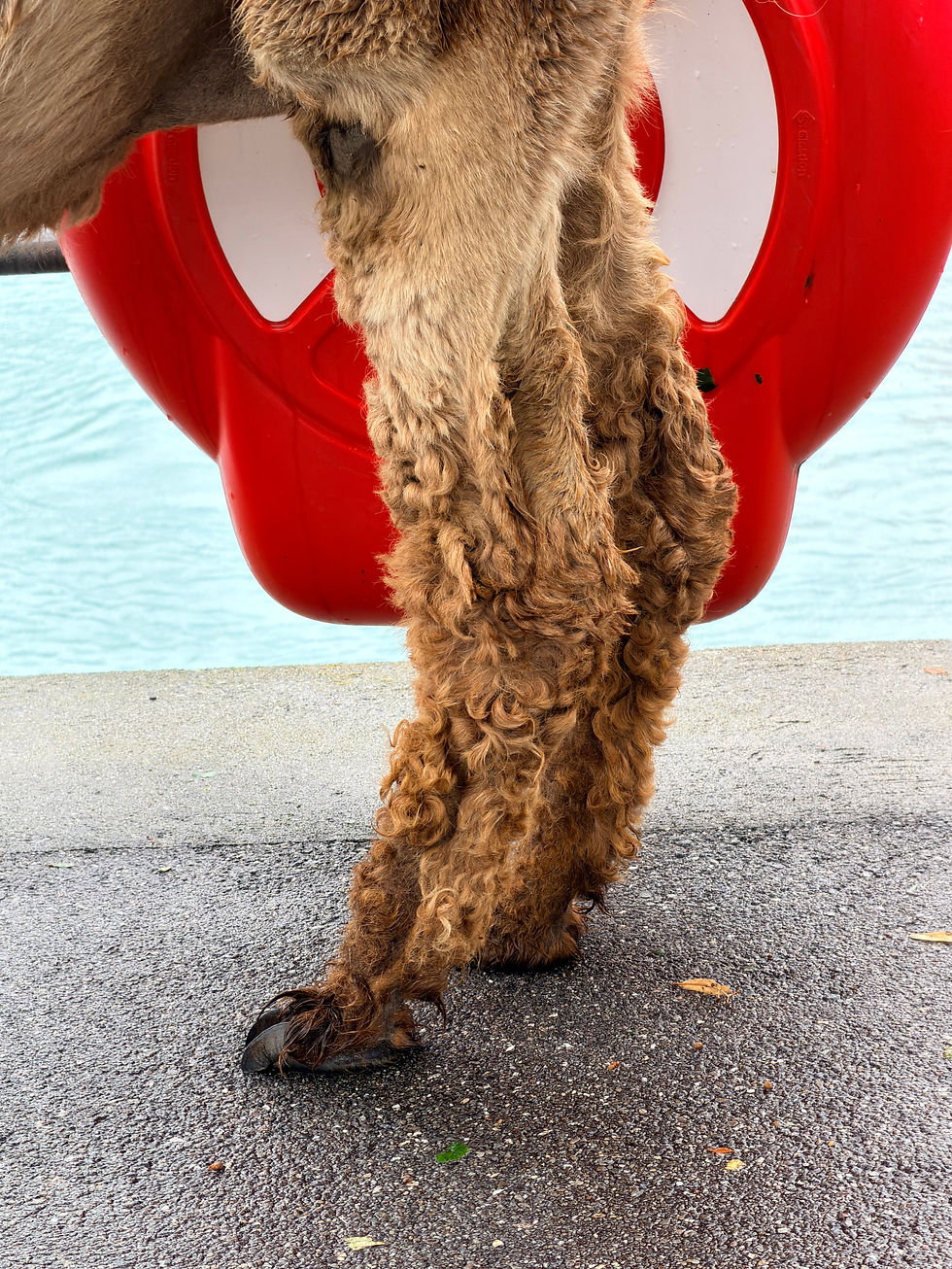
The ears are rather long and slightly curved inward, characteristically known as "banana" shaped. There is no dorsal hump. The feet are narrow, the toes being more separated than in the camels, each having a distinct plantar pad. The tail is short, and the fiber is long, woolly, and soft.


"In essential structural characteristics, as well as in general appearance and habits, all the animals of this genus very closely resemble each other, so whether they should be considered as belonging to one, two, or more species is a matter of controversy among naturalists."
"Llamas are not ruminants or modified ruminants. They do have a complex three-compartment stomach that allows them to digest lower quality, high cellulose foods. The stomach compartments allow for fermentation of tricky foodstuffs, followed by regurgitation and re-chewing. Ruminants (cows, sheep, goats) have four compartments, whereas llamas have only three stomach compartments: the rumen, omasum, and abomasum."
"In addition, the llama (and other camelids) have an extremely long and complex large intestine (colon). The large intestine's role in digestion is to reabsorb water, vitamins, and electrolytes from food waste passing through it. The length of the llama's colon allows it to survive on much less water than other animals. This is a major advantage in arid climates where they live."
"Llamas have an unusual reproductive cycle for a large animal. Female llamas are induced ovulators. Through mating, the female releases an egg and is often fertilized on the first attempt. Female llamas do not go into estrus ("heat")."
Like humans, llama males and females mature sexually at different rates. Females reach puberty at about 12 months old; males do not become sexually mature until around three years of age.
Llamas mate in a kush (lying down) position, similar to big cats and canines, which is unusual in a large animal. They mate for an extended time (20–45 minutes), also unusual in a large animal.
"The gestation period of a llama averages 11.5 months (350 days). Dams (female llamas) do not lick off their babies, as they have an attached tongue that does not reach outside of the mouth more than 13 millimetres (1⁄2 inch). Rather, they will nuzzle and hum to their newborns."
"A cria (from Spanish for "baby") is the name for a baby llama, alpaca, vicuña, or guanaco. Crias are typically born with all the herd's females gathering to protect against the male llamas and potential predators. Llamas give birth standing. Birth is usually quick and problem-free, over in less than 30 minutes. Most births occur between 8 am and noon, during the warmer daylight hours. This may increase cria survival by reducing fatalities due to hypothermia during cold Andean nights. This birthing pattern is considered a continuation of the birthing patterns observed in the wild. Their crias are up and standing, walking, and attempting to suckle within the first hour after birth. Crias are partially fed with llama milk that is lower in fat and salt and higher in phosphorus and calcium than cow or goat milk. A female llama will only produce about 60 milliliters (2 US fluid ounces) of milk at a time when she gives milk, so the cria must frequently suckle to receive the nutrients it requires."
For me, the llamas were more interesting to photograph than fog.


Fog coming up a hillside is known as upslope fog (or hill fog), which forms when wind pushes moist air up a slope, cooling it into water droplets as it rises.


The Harder Kulm is a funicular station at 1,322 meters (4,337 ft) overlooking the towns of Interlaken and Unterseen.
"It is located at the western end of the Harder, which in itself is the most western, forested ridge of the about 30 kilometers (19 mi) long, prominent mountain range dominating the north shore of the Lake of Brienz."
"The viewpoint belongs to the municipality of Unterseen with the slopes shared between the municipalities of Unterseen and Interlaken.


Did you know there are five types of fog?
What is fog?
"Fog is a meteorological phenomenon characterized by a dense collection of tiny water droplets or ice crystals suspended in the air near the Earth’s surface. These suspended particles scatter and attenuate light, reducing visibility. While fog can create stunning landscapes and mystical atmospheres, its impact on transportation, safety, and various industries cannot be underestimated."
Causes of fog:
"Understanding the causes of fog is essential to predict its occurrence and mitigate its impact. There are several mechanisms that lead to the formation of fog, each associated with specific atmospheric conditions."
Radiation Fog
"This type of fog occurs on calm, clear nights when the ground loses heat rapidly as the temperature drops, and the air near the surface cools, causing moisture in the air to condense into tiny water droplets. Radiation fog is commonly observed in valleys and low-lying areas and is most common during the fall and winter. This type of fog will gradually lift with sunlight the following morning."
Advection Fog
"Advection fog forms when warm, moist air moves over a cooler surface. As the warm air cools, moisture within it condenses into fog. Coastal areas are particularly susceptible to advection fog, where warm, moist air from the ocean encounters cooler land surfaces."
Steam Fog
"Steam fog, also known as sea smoke or evaporation fog, occurs when cold air moves over warmer water bodies, such as lakes or rivers. The relatively warm water causes the air above it to saturate quickly, forming fog. This type of fog is most common during the transition from late autumn to early winter and is commonly found in polar regions."
Upslope Fog
"Upslope fog develops when moist air is forced to rise over elevated terrain, such as hills or mountains. As the air ascends, it cools and condenses into fog. This phenomenon is prevalent in regions with significant topographic variations."
Frontal Fog
"Frontal fog results from the lifting of warm, moist air over a cold front. The cooling of the air leads to condensation and fog formation. This type of fog often occurs with the passage of weather fronts and can extend over large areas.
I was able to be an "information guide" today. Two couples got off the train at the Interlaken West station. They were looking for the train to Lauterbrunnen. Unfortunately, that train leaves from Interlaken Ost. Since I didn't have anything planned because of the rain, I hopped on the next train headed to the Ost station and showed them what train to take. That train can be confusing as the front of the train, after it stops in Zweilütschinen, goes straight to Lauterbrunnen while the back section veers off left and goes to Grindelwald. They are staying in another of my favorite places: the Lauterbrunnen Valley. The village of Lauterbrunnen gets its name – Lauter Brunnen (loud springs) – from the 72 waterfalls that can be found there.With the rain we have had the last 24 hours, I'm hoping the waterfalls are actually running and the mountains will be completely snow covered when the sun finally comes out. Wishing them a pleasant stay!


Comments