
Bern Bears Praying For Rain

Heat and less moisture has had an impact on Switzerland and even the bears in Bern are praying for rain.


One, two, three ......... jump in!


Rain was expected today, so we decided to go to Bern because the arcades would protect us. Bern features 6 kilometers (3.7 miles) of sandstone arcades. Well, I don't know what happened to the rain but we had heat and high humidity!!!
Rain is much needed inn this area. Climate change in the Bernese Oberland in 2026 is driving severe alpine droughts, rapid glacier loss, and an increase in natural hazards like mudslides and rockfalls.
"Major Impacts in 2026
Extreme Drought & Heat: The summer of 2026 brought record-shattering temperatures and severe dryness across Switzerland, with low river and lake levels straining local agriculture and forcing emergency animal slaughters in alpine pastures.
Rapid Glacier Melt: An early summer heatwave depleted winter snow reserves months ahead of schedule, leading to an exceptionally early "glacier loss day" in late June and accelerating the melting of multi-decadal ice.
Geological Instability: Thawing permafrost and shifting weather patterns are destabilizing high-altitude slopes, causing more frequent rockfalls, landslides, and torrential flooding in valleys like Oberland-Ost.
Ecosystem & Forestry Strain: Persistent heat and lack of moisture are causing premature leaf shedding and forest stress, raising long-term concerns about tree mortality and carbon release."
I can see it especially around the areas Lake Thun, Lake Brienz, and the Emmental region.
Regional Adaptation and Action
"Oberland-Ost Strategies: The 28 municipalities in the Wyss Academy for Nature East Oberland region are actively collaborating with the Canton of Bern and the University of Bern to develop localized climate-neutral and protective strategies.
Shifting Public Sentiment: Following the extreme weather of 2026, broad majorities of the Swiss public now express support for enhanced climate adaptation policies, particularly concerning building insulation and agricultural disaster support."
Did you know Bern is widely considered the prettiest city to visit in Switzerland thanks to its well-preserved medieval Old Town framed by the turquoise Aare River and distant alpine views? I feel Bern is relaxed, compact, and feels like a small, historic town even though it is the national capital.
The people living inn Luzern might have a difference of opinion. It has its covered medieval Chapel Bridge (Kapellbrücke), glassy lake, and dramatic mountain backdrop. Luzern is generally considered more visually stunning and postcard-perfect, while Bern offers a quieter, more authentic medieval city feel.
I would choose Bern if you want a picturesque, slow-paced medieval old town, or choose Zurich if you want a vibrant, cosmopolitan city with active nightlife and lake life.
If comparing Bern to Basel, Bern is better if you want traditional medieval charm and mountain access, while Basel is better if you want world-class art museums and a cosmopolitan city vibe.
So, I would say Bern is definitely worth visiting for tourists who appreciate well-preserved medieval history, relaxed city walking, and a less crowded feel than other Swiss hubs. Bern has a less crowded feel than other Swiss hubs.
The clouds over the Jungfraujoch and the Jungfrau were quite unique. Saw this while heading to the Interlaken West train station.


I especially love the Bern bears!!!! They were in the older section as this is the area they give them snacks/treats/ enrichment. Once the bears have found all the food, the bears are let back into the large enclosure which borders the Aare River.
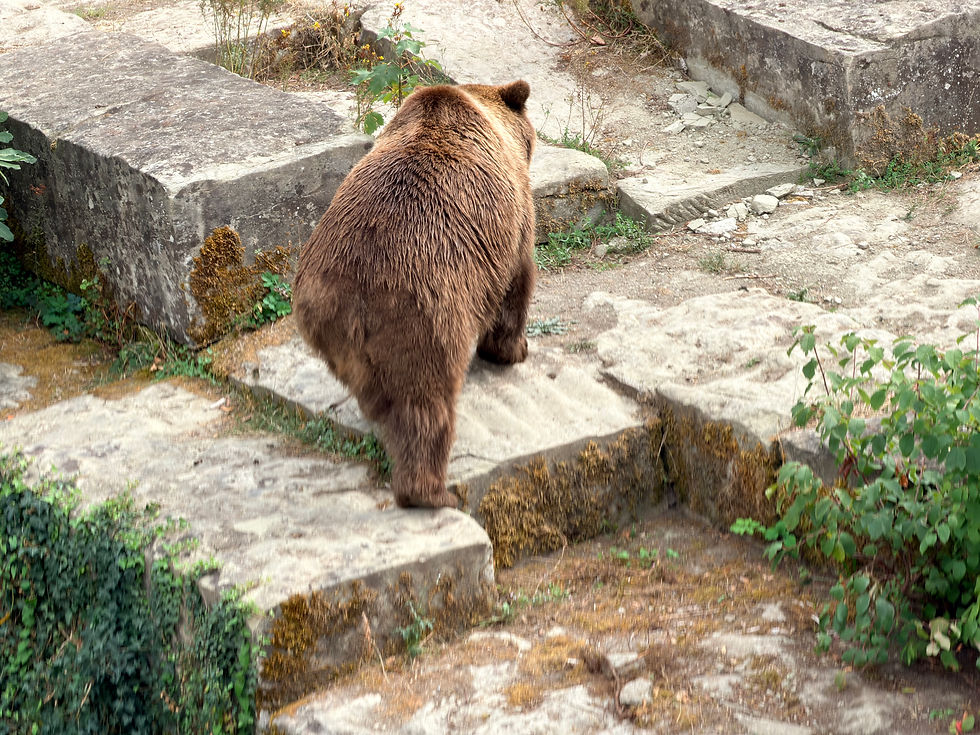

The fruit today was apples.


The heat today could make anyone grouchy and grumpy.
This one loves to pose!


Blowing bubbles
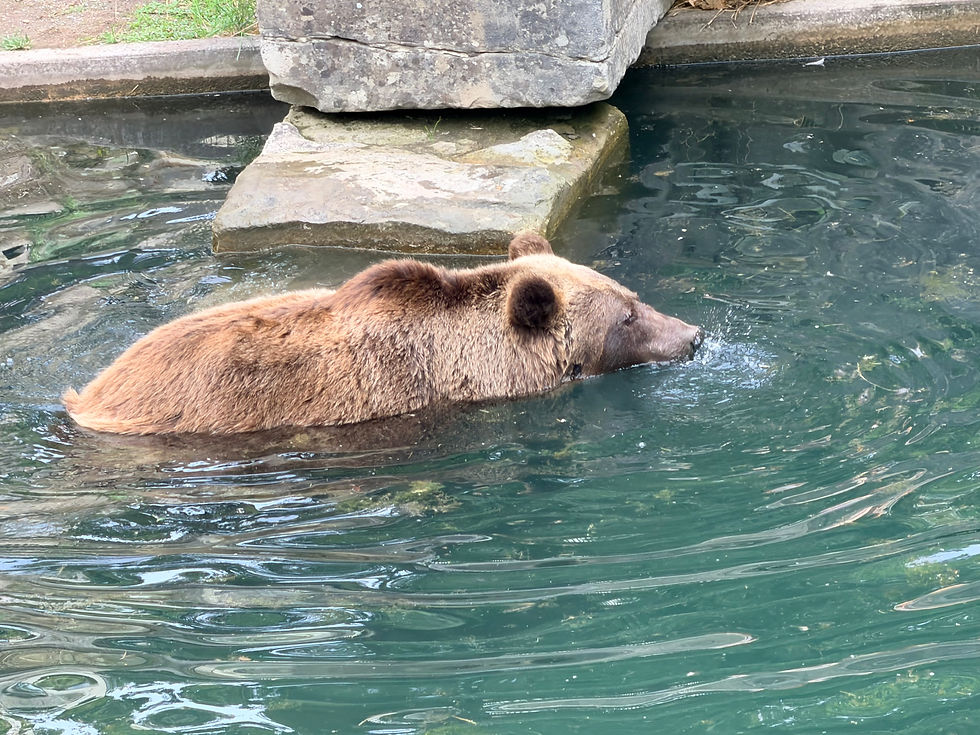


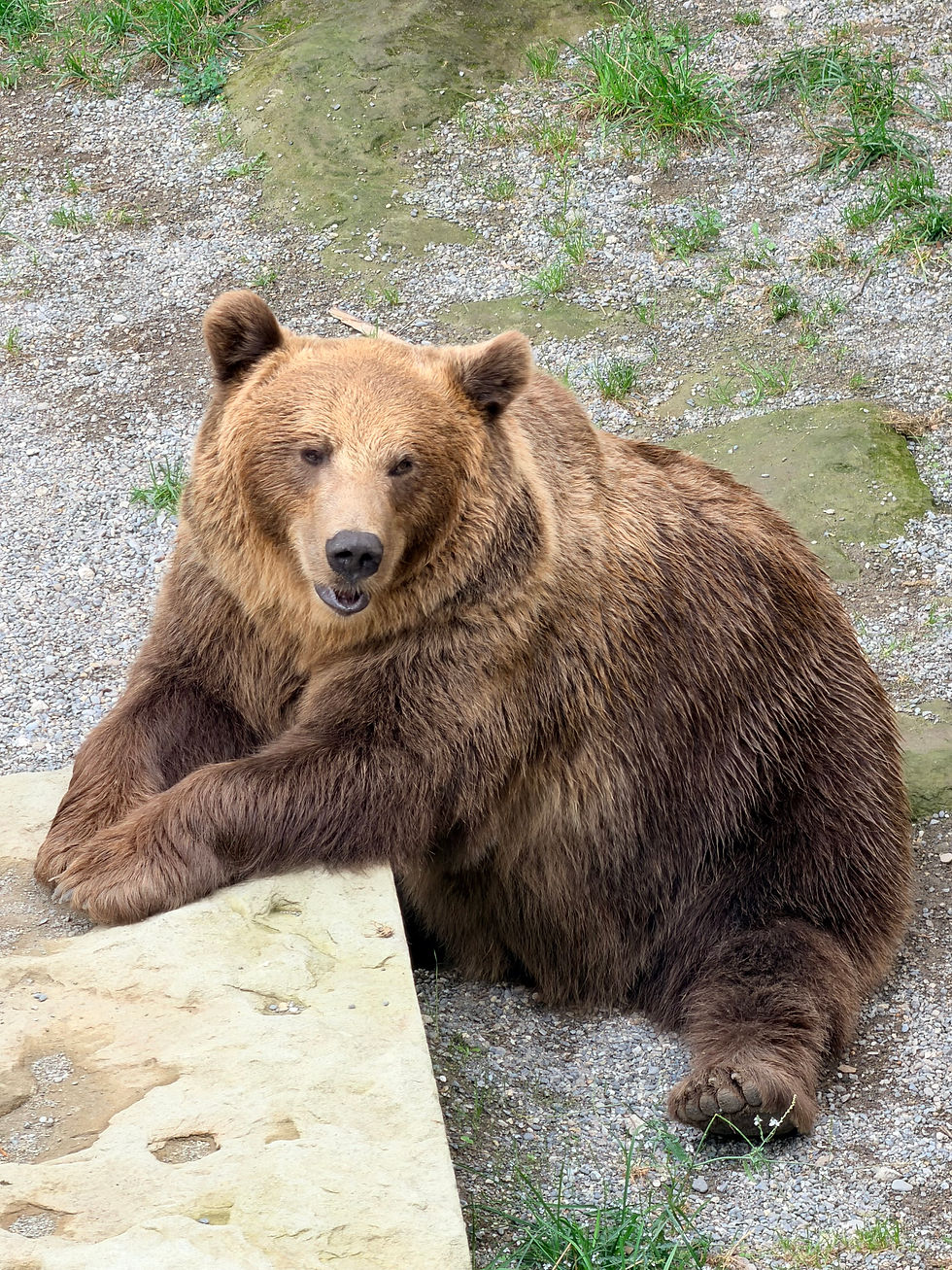


He is finished finding food and wants into the large enclosure


He pounds on the door to let someone know he wants out of here!
Besides landscapes, I so enjoy photographing animals!!
We always ship our bags to and from the airport in Zürich. This is the first time I have seen them actually taken off the train.


So much construction taking place at the Bern train station.

Check the main board to check the scheduled departures.

Symbol for meeting place.

Had to check out where the music was coming from.

Michael had his Korean lesson at this time, so he put on his headphones and started walking around the Old Town section. He was describing what he saw to his Korean tutor, An Song Yi, who lives in the Busan, South Korea area.


The Pfeiferbrunnen was built in 1545–46 by the Swiss Renaissance sculptor Hans Gieng, based on the 1514 Albrecht Dürer woodcut of the Bagpiper. Originally, it stood in front of the Gasthaus (hotel and restaurant) zum Kreuz, which was a hotel for traveling minstrels. In 1594, the building was renamed to Gasthof zum Storchen. Which led to the alternate name for the Pfeiferbrunnen, the Storchenbrunnen. This alternative name was popular until the end of the 19th century. During the renovation of 1874, an inscription was placed on the back of the statue, and the figures on the pillar were damaged. The current basin was built in 1889. Then, in 1919 the fountain was moved to the east from its original spot between Ryffli- and Storchengässchen, to its current location in front of Spitalgasse 21.


The only people busking around the area. Busking is the act of performing music, singing, dancing, or juggling in a public place to collect tips or donations from passers-by.
Street Performance: Performers (known as buskers) typically set up in public areas like streets, parks, or subway stations.
Spontaneous Nature: Most busking happens without formal scheduling, permits (where allowed), or fixed pay, relying purely on voluntary contributions.
Improvisation: In some technical or artistic contexts, "busking" can also mean improvising or performing live without full prior preparation.

Käfigturm (Prison Tower)
"In the past, Käfigturm was where criminals were interrogated and locked up, today it is a space for political discussions."
"Whether Ferdinand Hodler, one of Switzerland’s most famous painters of the 19th century, was really born in Käfigturm, is not completely sure. Fact is: before he was born, his mother worked there as a cook. She would go and fetch water from the nearby Seilerbrunnen (Anna Seiler Fountain), where she met her future husband and Ferdinand’s father."
"The fountain, located at the upper end of Marktgasse memorializes the founder of the first hospital in Bern. Anna Seiler is represented by a woman in a blue dress, pouring water into a small dish. She stands on a pillar brought from the Roman town of Aventicum (modern Avenches). On November 29, 1354 in her will she asked the city to help found a hospital in her house which today stands on Zeughausgasse. The hospital initially had 13 beds and 2 attendants and was to be an ewiges Spital or a perpetual hospital. When Anna died around 1360, the hospital was renamed the Seilerin Spital. In 1531, the hospital moved to the empty Dominican Order monastery St. Michaels Insel (St. Michael's Island) and was then known as the Inselspital, which still exists over 650 years after Anna Seiler founded it. The modern Inselspital has about 6,000 employees and treats about 220,000 individuals per year."

But... the Käfigturm was not known as a romantic place in the past: it was built in 1256 and was initially a defence tower and Bern’s city gate, but when the city expanded in the 14th century, its use changed. After the devastating fire in 1405, Käfigturm took over the functions of the destroyed Zytglogge (Clock Tower) and, from then on, served as a prison. In the rooms of the tower, suspects were interrogated and locked up. Today, scribbles on the dungeon doors remind us of the inmates’ fates."
"By the way: the murders, thefts and other crimes as well as interrogations, confessions and verdicts were documented in the so-called “Tower Books”.
"In 1641, a commission of the Bernese Council decided to tear down the 400-year-old, run down tower and rebuild it in the same spot. The extended tower now had more space for prisoners and served as a prison for another two centuries. After the new district prison was completed in 1897, the prisoners were transferred and the tower was used as an archive for the canton of Bern."
"Today, the Käfigturm stands for democracy, participation and exchange. It has been the home of the country’s political forum since 1999 and hosts many exhibitions and events on various political topics. The association “Polit-Forum Bern” (Political Forum Bern) has been running the forum since 2017 and is made up of the city and the canton of Bern, the Civic Community Bern, the Roman-Catholic Central Conference and the Federation of Swiss Protestant Churches."

Serious chess game taking place. Lots of opinions shared through head shakes for and against..


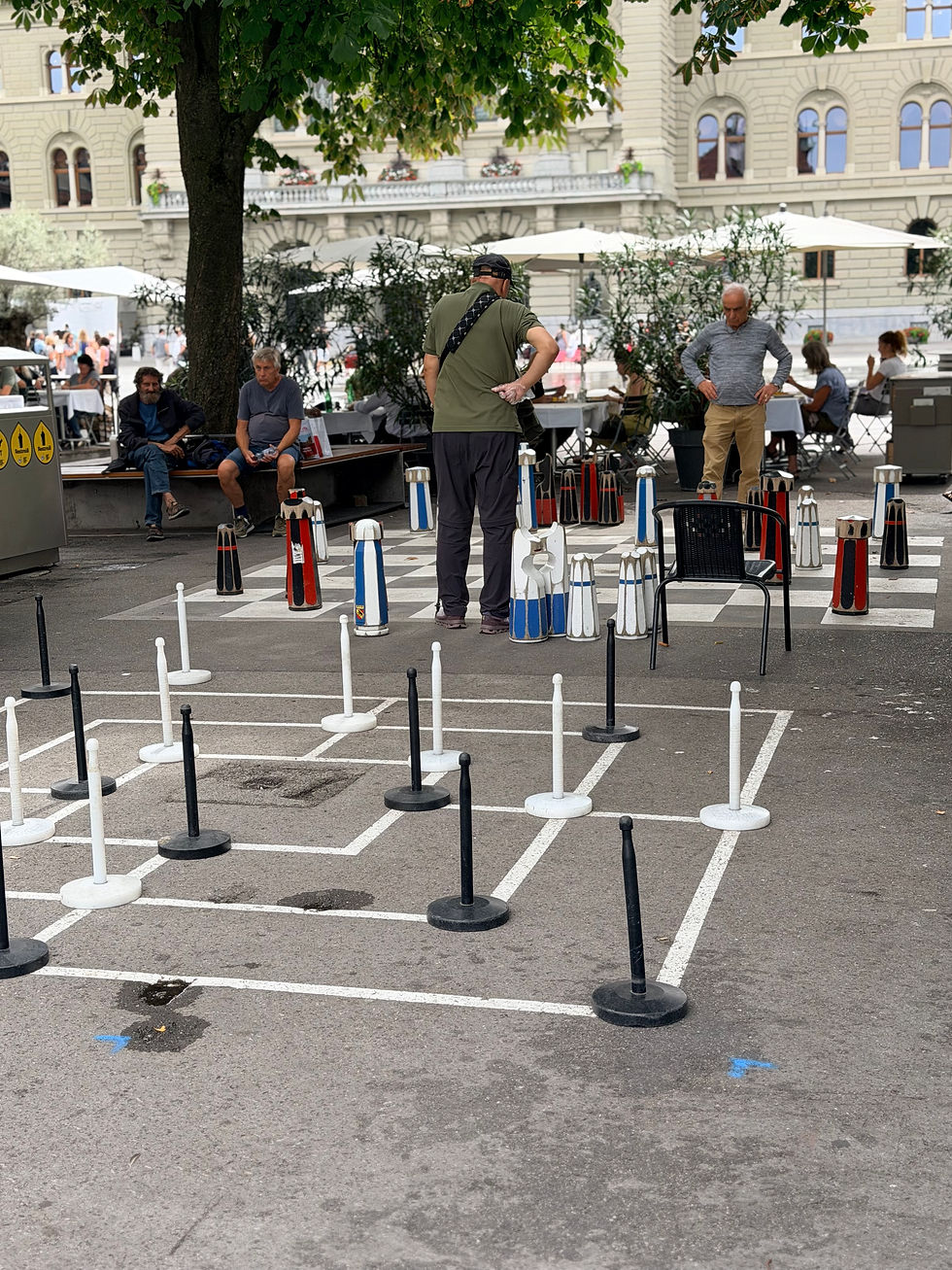
Parliament
"The Parliament Building, also referred to as the Federal Palace, was built between 1894 and 1902 according to plans drawn up by the architect Hans Wilhelm Auer. It was officially inaugurated by the United Federal Assembly at a ceremony on April 1, 1902. The Parliament Building stands between the Federal Palace’s West Wing (built 1852–1857) and East Wing (built 1888–1892). It is the final element and architectural highlight of the Federal Palace project. 95% of the materials used were sourced from within Switzerland. The symbolic intention was to illustrate the cultural and material diversity of the country and of its people. For the first time in its over 100-year history, the Parliament Building underwent a thorough renovation between 2006 and 2008, which also involved substantial structural alterations."
"In addition to the farmers’ market, there are also political manifestations, concerts, state visits, and sporting events that take place on Bundesplatz. Surrounding the square are the headquarters of the Swiss National Bank to its left.

"The Berner Kantonalbank (Cantonal Bank of Bern) to its right as well as Bärenplatz with its many restaurants at the North end. Behind the Bundeshaus lies the Bundesterrasse (literally: federal terrace), a promenade that spans all the way from the Kleine Schanze park to the historic Bellevue Hotel which, once upon a time, saw heads of state, artists, actors, and secret agents come and go. The Bundesterrasse is a place where locals like to meet to chat, enjoy a sundowner with a view, read a book, or sunbathe. From here, you can reach the main station in only five minutes on foot, and the popular Marzili neighbourhood and the River Aare in ten."


Parliament Building and Parliament Square
The Bundeshaus in Bern is the heart of Switzerland’s democracy: the parliament holds its meetings under the grand dome, the west and east wings house parts of the federal government and administration. The large square in front of the building as well as its long terrace are popular, lively meeting places.


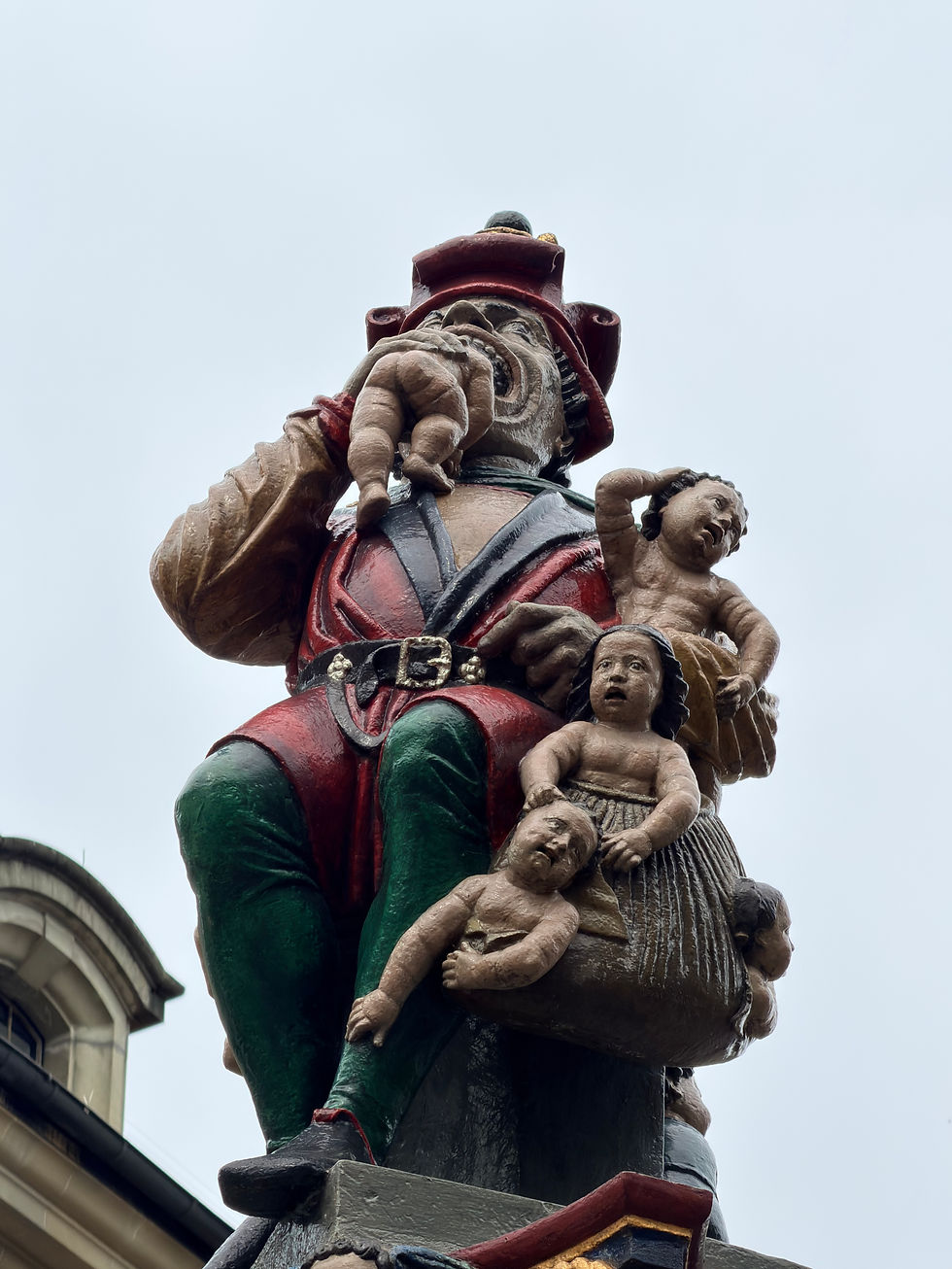
"The Kindlifresserbrunnen fountain sculpture depicts a seated ogre devouring a naked child. Placed at his side is a bag containing more children. Because the ogre is wearing a pointed hat resembling a Jewish one, it has been speculated about the possibility of the ogre being the depiction of a Jew as an expression of blood libel against Jews. Another theory is that the statue is the likeness of Krampus, the beast-like creature from the folklore of Alpine countries thought to punish children during the Christmas season who had misbehaved. According to other theories it is a depiction of the Greek titan Cronus eating his children or the Roman Saturn eating the months, though Cronus should have six and Saturn twelve rather than the sculpture's eight."
"Another theory is that it represented Cardinal Schiner who led the Swiss Confederation into several bloody defeats in Northern Italy. An alternative theory is that it is a depiction of the older brother of Duke Berchtold (founder of Bern) who it is claimed, was so incensed by his younger brother's overshadowing of him that he collected and ate the town's children. Such an incident is not recorded in Bern's history books. A final theory is that it is just a carnival character intended to frighten disobedient children."
"Another theory is the eight children depict the eight cantons of the Old Swiss Confederacy and the Ogre is an enemy (possibly Charles the Bold, Duke of Burgundy) trying to gobble the cantons up. This would match with the fountain's base which shows a frieze of armed bears going to war, including a piper and a drummer. The frieze may have been designed by Hans Rudolf Manuel Deutsch."
The Kindlifresserbrunnen is an important object in the 1973 novel L'Ogre (The Ogre) by Jacques Chessex.



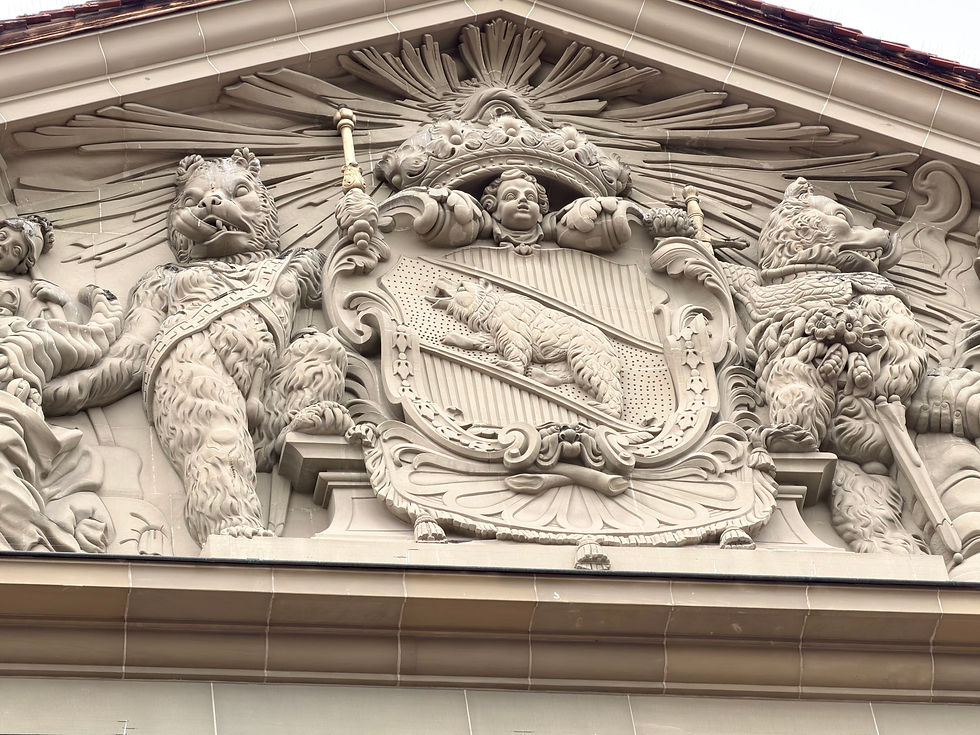
The Kornhaus is a former granary and today a cultural center located at Kornhausplatz 18 in Bern's Old Town .
"The Granary, built of Bernese sandstone, was constructed from 1711 to 1715 according to plans by the brothers Hans Jakob and Abraham Dünz the Younger. The municipal granary office was established in 1482 and endowed with the patronage rights to Kirchberg, Utzenstorf, Kriegstetten, and Ersigen, along with tithes, rents, and other dues. Until 1617, the granary office was administered by a granary warden from the Small Council , and thereafter by the Great Council. Wine and grain were stored in the granary to pay the city's salaries."
"In 1895, the municipality of Bern architect commissioned Paul Adolphe Tièche to convert the building into the Museum of Applied Arts, with a post office housed on the ground floor. Between 1896 and 1898, architect Friedrich Schneider transformed the cellar into a large banquet hall. f
Following a competition, Rudolf Münger decorated it literary with poetic frescoes . He painted the walls and ceilings in the Art Nouveau style with all the coats of arms of the districts of the Canton of Bern. The cellar now houses the Kornhaus cellar restaurant , colloquially known as Chübu ( Bernese German for "bucket"). The Kornhaus also contains the main library of the Kornhaus libraries , the Kornhausforum – an exhibition and discussion venue – and a café ."
The Kornhauskeller restaurant and the café are run by Bindella ; the latter is to be replaced by a pizzeria. The current lease agreement between Bindella and the city of runs until 2030.



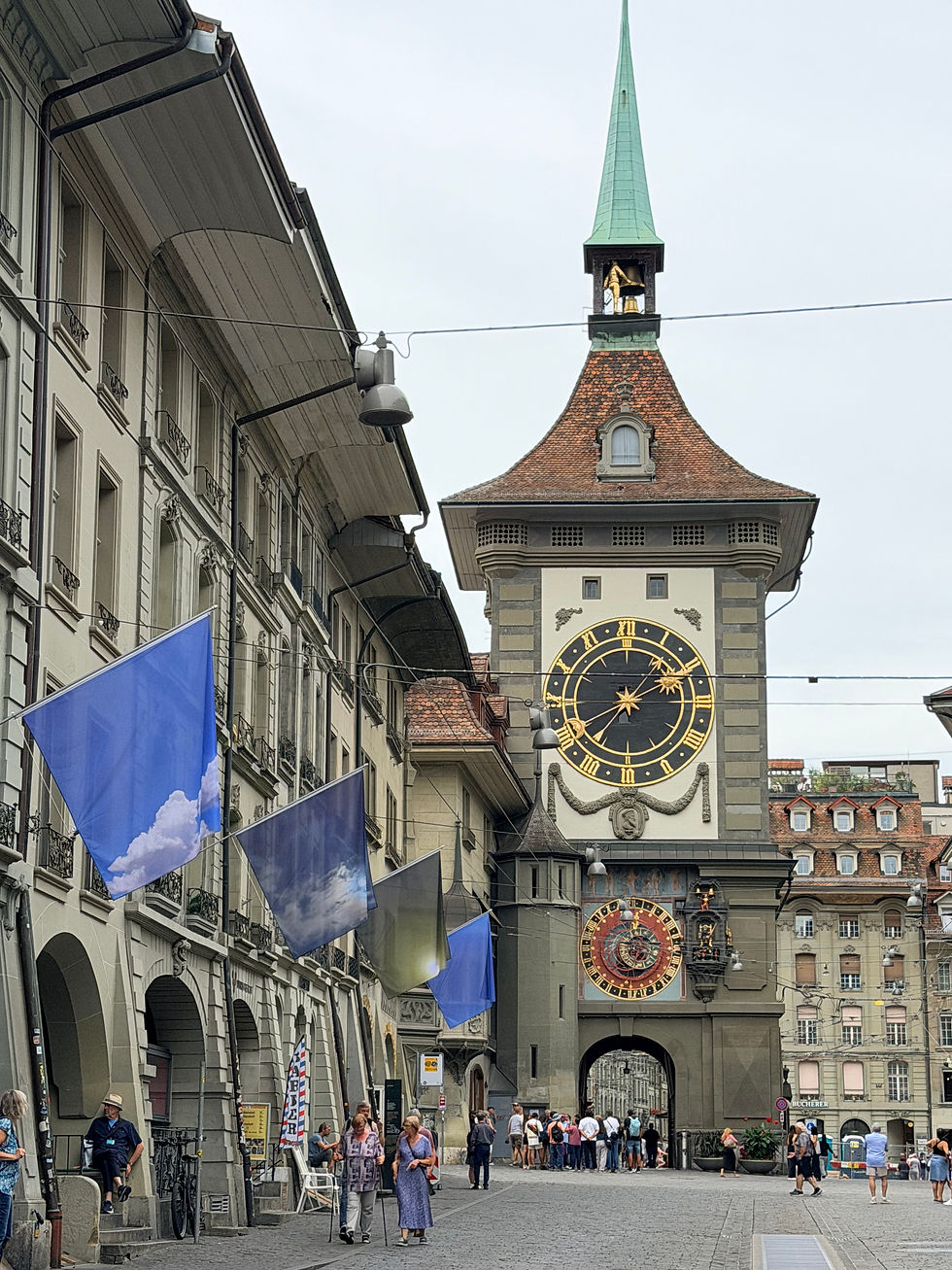
Zytglogge (Clock Tower)

Every hour on the hour, people gather in front of the Zytglogge (Clock Tower) to watch this unique spectacle. That’s when the show starts and you can see bears, a jester, a golden rooster and even Cronos, the god of time, ringing in the new hour.


The astronomical clock, known as the astrolabe, and the musical mechanism dating from 1530 have made the tower particularly famous.
"Just before the hour changes, a crowing rooster announces a wonderfully whimsical puppet show: Bears dance in a circle, a jester mischievously strikes the hour too early, quarter-hourly chimes sound from the tower, Cronos, the god of time himself, turns the hourglass around, and finally, the gilded knight Hans von Thann strikes the bell in time with Cronos’ swinging scepter."
The astronomical clock above the entrance of the Zytglogge (Clock Tower) is a true work of art. The rotating spheres are an exact representation of the celestial bodies, with the earth at its center and the sun, moon and stars orbiting around our planet.
This complex representation of the northern hemisphere always shows the current sign of the zodiac, the phase of the moon, the time of sunrise and sunset, and the date. Frescoes of the five planetary gods from Roman mythology adorn the space above the astrolabe.


One Sky Flags
WE ALL LIVE UNDER ONE SKY !
September 1 – 26, 2026
UNESCO World Cultural Heritage Site, Old City of Bern In Cooperation with Verein Bühnen der Hauptstadt and Embassies in Bern
"Up to 89 Embassies in Bern are invited to contact participants in their home country to talk about peace and freedom: their stories and experiences, commitments, fears and hopes and to take a picture of the sky reflecting their emotions. ONE SKY FLAGS will then be hoisted in the Old City of Bern, the voices of the participants be heard and the Verein Bühnen der Hauptstadt will deepen the topic."
"The idea is simple: People from as many countries as possible photograph the sky and share a personal story about freedom and peace. From these images, over 80 flags will be created and hoisted in Bern's Old Town between the Zytglogge clock and the Nydegg Bridge. A sea of flags in shades of dawn, sky blue, cloud gray, and night black will fly in Kramgasse and Gerechtigkeitsgasse for a month. Passersby can listen to the participants' original voices via an app."
"The sky has captivated Yvonne Lee Schultz. "The sky is a nomad, it is everywhere at once," says the Berlin-based artist, "it connects us, union borders." She is now calling for participation in her art project "One Sky Flags,"" which will shape the cityscape of Bern in September."
The idea of displaying special flags in Bern's old town is not new. For the 125th anniversary of BSC Young Boys, various emblems from the football club's history were hung up.
"For Yvonne Lee Schultz, the Bern flag display is her biggest sky flag project to date. The impetus to realize it in Bern came from Christiane Wagner, the director of the Theater on Effingerstrasse. She had followed Yvonne Lee Schultz's work and had the idea of hoisting the flags on the flagpoles mounted in Bern's old town. Several Bernese theaters are offering a support program for the event."




A gargoyle is a carved stone waterspout shaped like an ugly or fantastical creature, designed to project rainwater away from a building's walls. A channel is cut into the back of the stone figure so that rainwater from the roof gathers and pours out through its open mouth, protecting the masonry and mortar from erosion.
The word comes from the Old French word gargouille, meaning "throat," which shares a root with the word gargle.
In medieval folklore, these figures were thought to act as protective guardians that frightened away evil spirits.
They also served as visual reminders of the spiritual dangers or hell awaiting those who did not attend church. Gargoyles symbolize protection against evil, spiritual watchfulness, and the chaos of the outside world contrasted with the sacredness of a church. Medieval folklore held that the grotesque and terrifying faces of gargoyles could scare away real demons and malicious spirits. Placed high on cathedrals, they served as eternal sentinels protecting the holy ground within. Their demonic or monstrous forms represented the existence of sin, hell, and damned souls existing outside the safety of the church. During eras when most people could not read, these carvings visually communicated the dangers of straying from the faith.

The Last Judgement


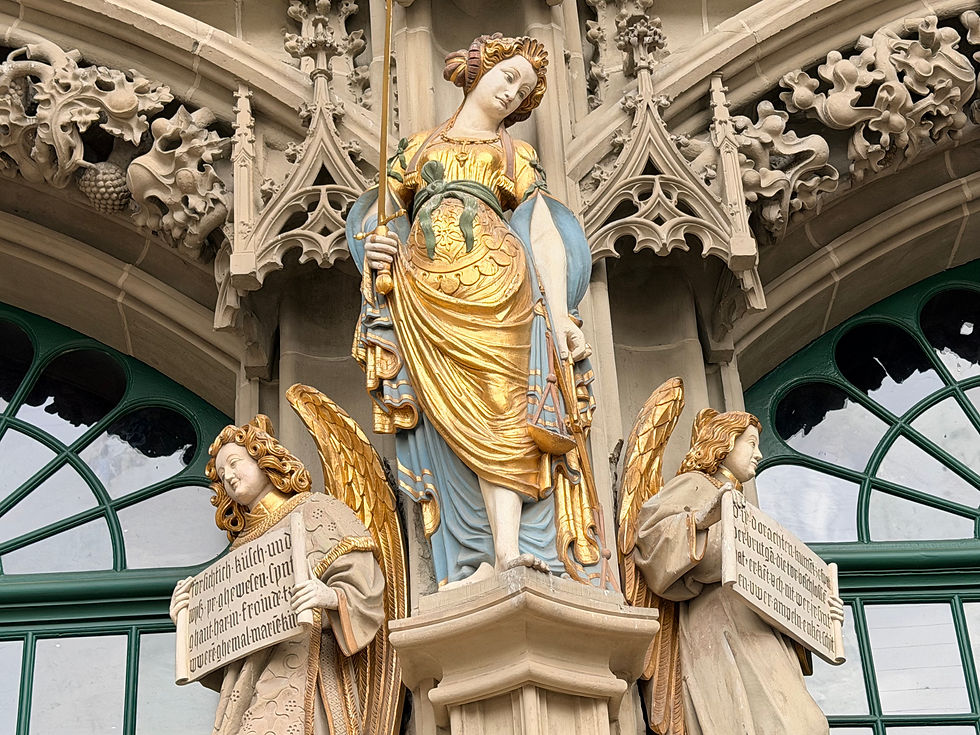


"The Last Judgment, or Judgment Day, is a central eschatological event in various Abrahamic religions, where God sets to reward the virtuous and punish the sinful. In Christianity, the Last Judgment marks the return of Jesus Christ to evaluate all of humanity, both the living and the resurrected dead (Jn 5:28–29). According to biblical apocalyptic literature, Christ will sit upon a "great white throne" (Rev 20:11) to render a definitive verdict based on an individual's faith, words, and deeds (Mt 12:36; Rm 2:6). This divine audit results in a final separation in which the righteous are granted eternal life in the presence of God, while the wicked face eternal punishment (Mt 25:31–46). Ultimately, this event serves as the supreme manifestation of God’s justice and His definitive triumph over evil and death (1 Cor 15:24–26)."
"In Islam, the Day of Judgment (Yawm al-Qiyamah) is a fundamental article of faith involving the bodily resurrection of all humanity. According to the Quran, every individual will be held accountable before Allah, with their deeds weighed on a divine scale (Mizan). In both traditions, this "divine audit" results in a final separation: the righteous enter eternal paradise (Jannah), while the wicked face eternal punishment (Jahannam). Numerous Shia and Sunni hadiths describe various events preceding the Day of Judgment. Among these are the emergence of the Mahdi, the appearance of the Masih ad-Dajjal, and the subsequent descent of Isa (Jesus), who will accompany the Mahdi and defeat the Antichrist. This will be followed by a sequence of events culminating in the sun rising from the west and the beginning of the Qiyāmah (Judgment Day). The Last Judgment has inspired numerous artistic depictions, including painting, sculpture and evangelical work."
"In Christianity, there are three main beliefs about who will be saved (go to heaven) and who will be damned (go to hell) on Judgment Day. All three beliefs are based on biblical interpretation and Christian tradition. Some Christians who believe in universal salvation say most people and angels will go to heaven on Judgment Day. Some Christians who believe in double predestination say most people and angels will go to hell on Judgment Day. Other Christians who disbelieve in universal salvation and double predestination say the number of the saved and of the damned on Judgment Day is unknown."
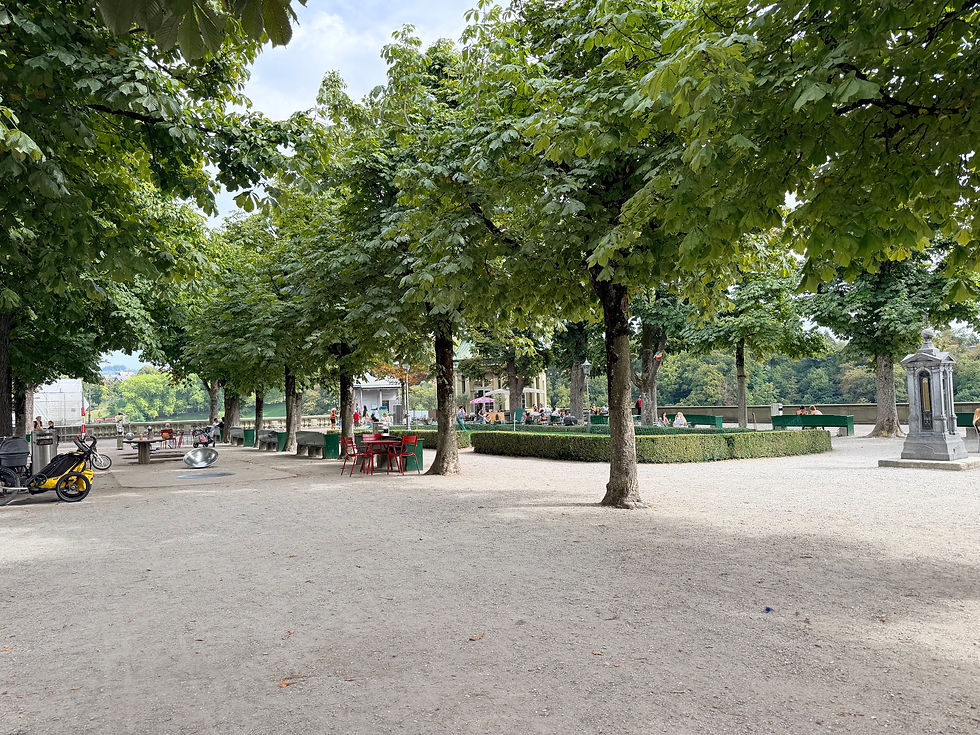
Missed these the last time we were in the park behind the Bern Cathedral.

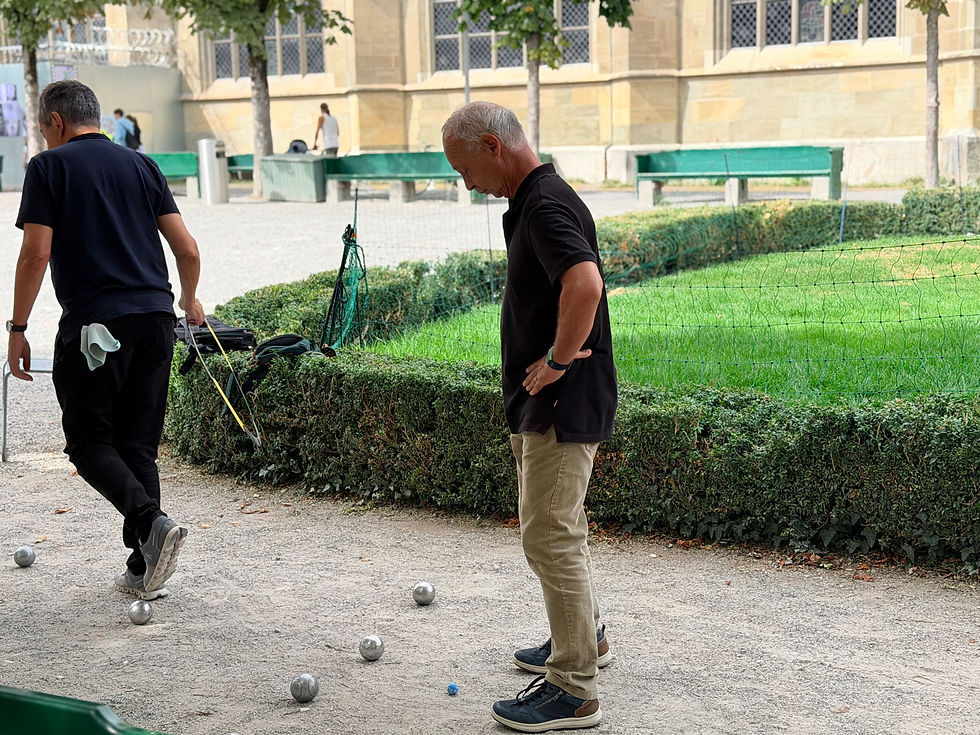


Trying to figure how it worked. I knew how.

Finally took a picture of the haunted house. Doesn't seem as though anyone has moved in yet.

Unique handles


What is the best way to end the visit to Bern? It's a stop at Sprüngli at the train station for a truffle!!!!


Comments