
Tongdosa Temple
- Deborah Kade
- Mar 30
- 8 min read


Tongdosa Temple is one of Korea’s most significant Buddhist temples, Tongdosa is unique in that it enshrines sacred relics of the Buddha rather than statues. Its peaceful grounds and historic halls set a calm tone for the day.


"Tongdosa Temple, esteemed for its establishment in 643, is a revered site recognized as a UNESCO World Heritage. This temple proudly houses Buddha's genuine sacred relics. It also boasts an array of significant Buddhist cultural treasures, such as the Daeungjeon Hall, the Gilt-Bronze Vairocana Buddha, and the Buddhist Museum. Additionally, the temple offers a templestay program for visitors."
"Tongdosa temple is one of Korea's five "Palace of the Jewel of Nirvana" temples, where the relics of the Buddha substitute for a statue. Precept Master Jajang brought the relics, including part of the Buddha's robes, from China and enshrined them (646C.E). Consequently, the temple represents the Buddha of Korea's three Jewel Temples and it also is a Full Monastic Training Temple, with Yeongchuk Monastery."
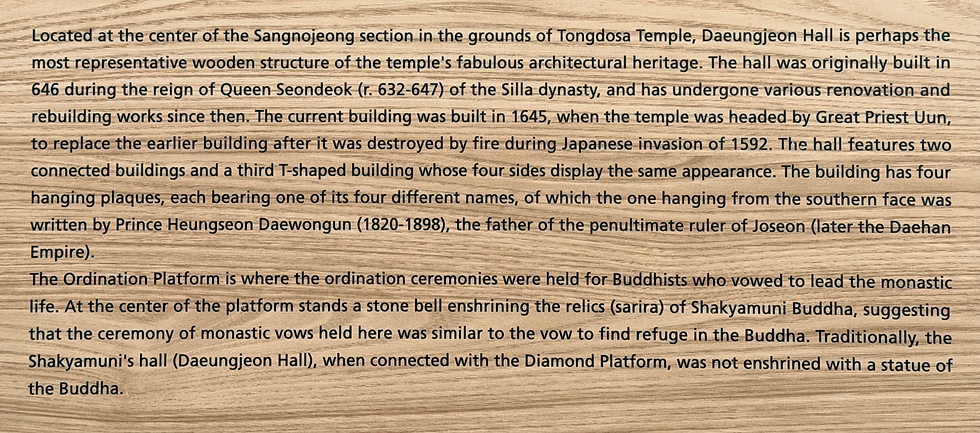
"Mt. Yeongchuk surrounding the temple resembles Mt. Grdhrakatu where the Buddha delivered the Lotus Sutra and Tongdo, the name of temple means "Pass through (to) Enlightenment." In addition, all monks have to pass through the Diamond Precept Platform (Geumganggyedan) at the temple, where ordinations take place."
It is traditionally a Seon Temple which has had many famous monks including Seon Master Gyeongbong.
"Before entering the temple compound, the visitor has to pass over the "windless" bridge which leads into a forest of "windless" pines. Most temples have a bridge-often over a wonderful rushing torrent- before the gates to the compound."

Dancing pine trees in the cold wind

"There are numerous temple buildings between the Iljumoon(one pillar gate) and the Daeungjeon(Main Buddha Hall)."


The Tongdosa Museum that is the only one in the world dedicated to the preservation of Buddhist temple paintings.
As far as the number of buildings is concerned, there are over 50 temple buildings inside of temple compound, the largest temple in Korea.
Male and female guards. They are at the beginning of every village.


Many of these ancient buildings look today just as they did in the past. There are many small (20) hermitages scattered around the temple grounds. The river-valley and forest near Tongdosa are an ecological paradise.


White dandelions


Wood violet

The Korean name for these are "dove balls".


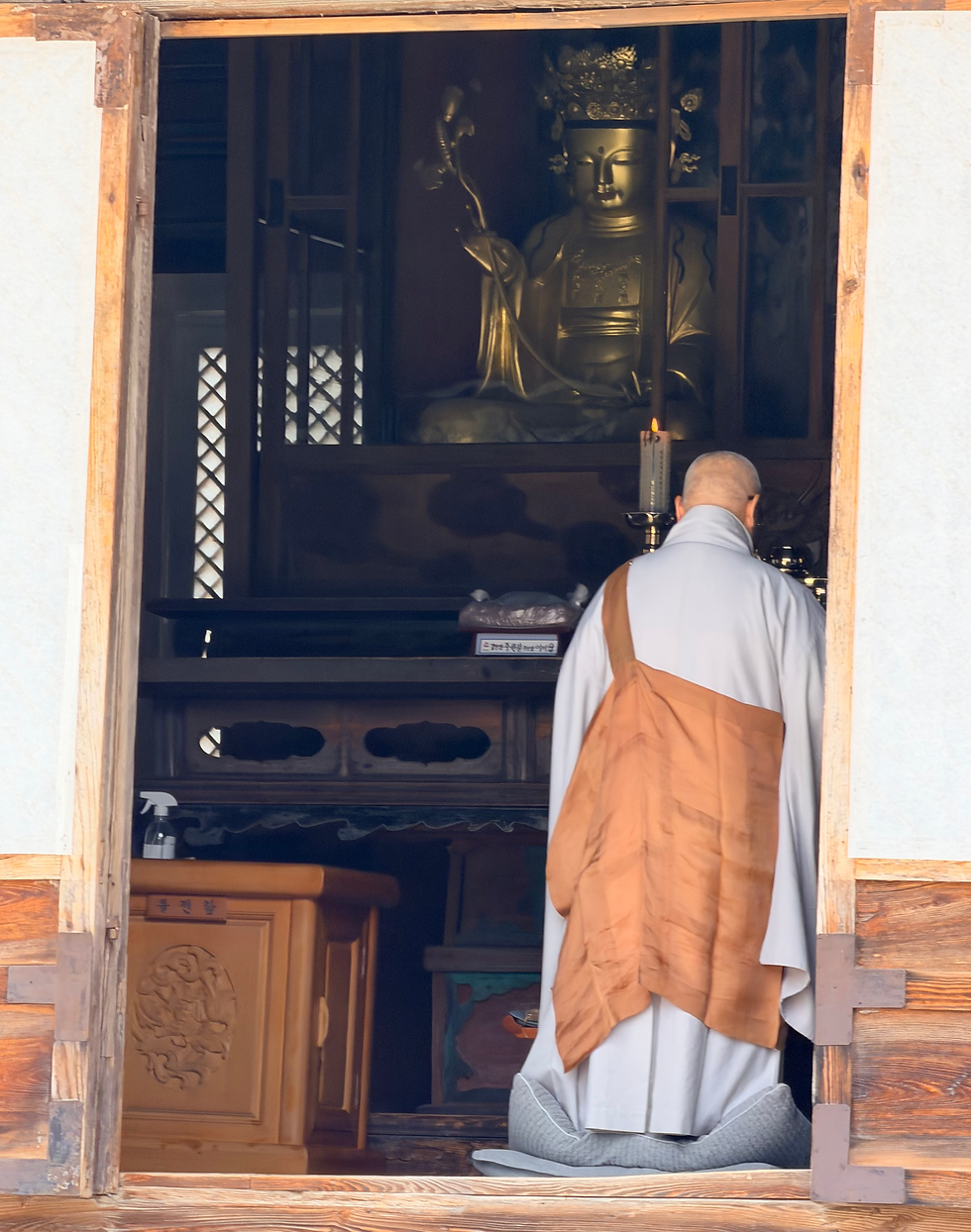
If a monk is wearing colored attire, he is performing a ceremony.




Young is crossing the bridge

Young is telling Michael the story about the blind dragon.
The legend of the Nine Dragons, often associated with the founding of Guryongsa Temple in Wonju tells of a lake inhabited by nine dragons. When monks (or sages) sought to build a temple there, the dragons refused to leave, causing a massive storm. After a test of spiritual power, eight dragons left, but one stayed.
"The Nine Dragons: Initially, nine powerful dragons controlled the lake and refused to vacate for the construction of a Buddhist temple.
• The Storm and Test: The dragons challenged the builders by bringing a storm with enormous rain, but the Buddhist leader matched their power.
• The Eight Departed: Eight of the dragons, recognizing the spiritual superiority of the Buddhist monks, decided to leave the area.
• The Youngest/Blind Dragon: The youngest (sometimes described as blind or slow) dragon remained behind, unable to leave with the others. According to the legend, this dragon stayed, and the temple was named Guryongsa, or "Nine Dragons Temple," in memory of its transformation from a site of chaotic energy to a place of peace."
"This tale is a classic example of Buddhism's early interaction with local shamanistic beliefs, where indigenous spirits (the dragons) are converted to protectors of the new religion."

"While the specific scenario of "crossing while a monk is chanting" may be a contextual teaching or a specific local proverb within Korean Seon (Zen) Buddhism, it aligns with several core themes in Korean Buddhist tradition:
• The Symbolic "Bridge": Korean temples often feature bridges crossing small streams before arriving at the main temple area. This serves as a physical and mental threshold, leaving behind worldly attachments and entering the "pure land" or sanctuary of the Buddha.
• The "Other Shore": Enlightenment is frequently described in Mahayana Buddhism as reaching the "other shore" (pāramitā), away from the ocean of samsara (suffering/reincarnation).
• Chanting as Guidance: Chanting (Yeombul) is a way to settle the mind and invoke mindfulness, assisting in making the transition from a chaotic state to a "pure" state of consciousness. The act of crossing while a monk chants implies a conscious action—an "intention to cross"—that aligns with the spiritual journey.
• Active Participation: The saying emphasizes that, just as one must physically cross a bridge to reach the other side, a person must take personal responsibility and show willingness to leave behind their attachments to achieve enlightenment."
Nine dragons

"This idea is disarmingly simple, suggesting that the journey to enlightenment is about mindful action, dedication, and letting go of the ego, just as one leaves behind a raft after crossing a river."


We prayed here.


Once a girl fell in love with a very handsome monk who could not return her affections because monks are not allowed to marry. Because of this rejection she hanged herself. She was reincarnated as a tiger. The tiger went on to destroy many villages. When the tiger was finally vanquished, it bled out upon a rock. That rock can be seen in the Buddhist temple complex.

These jars are filled with some cooking ingredient like soy sauce, chili paste, soybean paste, or even kimchi.


This jar is filled with soy sauce

Fermented soybean paste

This is placed so insects, mold, rain, and other solutions do not get into the jar that is filled with some cooking ingredient.

Michael bowed as the monk passed. The monk was impressed and gave him a scorched rice cake.


The oldest building. Young asked the woman about the salt jars placed at the corners of the buildings.


The woman then gave us some rice cakes


The pots containing salt placed on the eaves or corners of Korean Buddhist temple buildings are a traditional, symbolic, and shamanistic practice intended to prevent fires (known as hwajaemagi in Korean).
Here are the key details regarding this practice:
• Symbolism of Sea Salt: Salt is believed to represent the sea or seawater. Because the dragon god (Yongsin) is believed to reside in the water and have the power to control it, placing salt in these pots is a symbolic way of asking the dragon to protect the wooden buildings from fire.
• Shamanistic Influence (Fire Dragon King): This ritual is often associated with the "Fire Dragon King" (Hwaryongwang). Even though temples are Buddhist, many incorporate shamanistic elements. This includes offering salt to the dragon to protect the buildings, particularly from the destructive "fire energy" often associated with mountains or, according to traditional pungsu (geomancy), specific surrounding peaks.
• Protection of Wooden Structures: Because traditional Korean temples are largely made of wood and paper, they are extremely susceptible to fire. This tradition serves as both a spiritual appeal for protection and a way of expressing caution and devotion.
• Ceremony and Placement: In some temples, such as Tongdosa and Haeinsa, these salt jars are placed on the eaves or roof corners and are often renewed during specific rituals.
In addition to salt, some older, royal, or very important wooden structures used other symbolic items like japsang (small earthen figures) on the roof to guard against fire and evil spirits


The newest building


We then drove to the Seounam Hermitage. This quiet hermitage is especially known for the large collection of earthenware jars (onggi) used to ferment traditional Korean soybean paste (doenjang) and soy sauce (ganjang), all handmade by the monks.


Can you spot the earthenware jars?


You’ll also find artistic highlights such as a ceramic interpretation of the Tripitaka Koreana, and a small pond inspired by the prehistoric rock carvings of BangudaePetroglyphs, adding a cultural and symbolic touch to the serene landscape.


The 80,000+ tablets are known as the Tripitaka Koreana (or Palman Daejanggyeongin Korean), which is the world's most comprehensive and oldest intact version of the Buddhist canon in Hanja script.
"Here is the story behind the tablets:
"1. Purpose: A Spiritual Defense Against Invaders
The Tripitaka Koreana was not created simply to record texts, but as an act of faith to protect Korea during a time of crisis.
• The Mongol Invasions: In the 13th century (1231–1270), the Goryeo Dynasty was being brutally invaded by the Mongol Empire.
• Spiritual Armor: King Gojong ordered the creation of these woodblocks to invoke the power of the Buddha to defend the country, believing that producing the ultimate collection of Buddhist scriptures would bring divine help to repel the Mongols.
• A Second Attempt: An earlier set of woodblocks (the Chojo Daejanggyeong) was destroyed when the Mongols burned the Buinsa Temple in 1232. The 80,000 tablets were a massive, 16-year project (1236–1251) to replace them."

"2. The Remarkable Production Process
The creation was a national endeavor comparable to a modern Apollo space program.
• Number of Tablets: There are 81,258 woodblocks (often referred to as 80,000).
• Scale: If stacked, they would be as tall as Mount Paektu (2.74 km); if lined up, they would stretch 60 km.
• Material & Treatment: Birch and wild pear trees were used. The wood was soaked in seawater for three years, cut, boiled in salt water, and dried in the shade for another three years to prevent warping and decay.
• Perfection: Each block was coated in lacquer to repel insects and capped with metal to prevent warping. The accuracy is so high—with over 52 million characters—that it is believed they were carved by a team of dedicated monks, yet the calligraphy is so uniform it looks as though a single person carved them all."

"3. The Library: Janggyeong Panjeon
The tablets are housed in a specialized storage area within Haeinsa Temple called the Janggyeong Panjeon, which is a UNESCO World Heritage site.
• Scientific Design: Built in the 15th century, these four long buildings were designed to allow natural ventilation and control temperature and humidity to keep the wooden blocks safe from rot, rodents, and insects.
• Survival: These buildings have survived over 500 years, including the tumultuous Korean War, keeping the tablets in pristine condition without modern technology."
"4. Miraculous Survival and Significance
During the Korean War (1951), an air force colonel was ordered to bomb Haeinsa Temple to destroy North Korean guerrillas hiding there. He disobeyed the order because he recognized the invaluable cultural, religious, and historical importance of the Tripitaka Koreana, saving the repository from destruction.
• Status: The Tripitaka Koreana is National Treasure No. 32.
• Uniqueness: It is the most complete and accurate collection of Buddhist texts in the world, often referred to as the "Dharma-jewel Monastery of Korea"
We ate at "One Fine Day", a seaside restaurant celebrated for its abalone specialties. Signature dishes include:
abalone porridge

abalone risotto,

soy-marinated shrimp with abalone rice

The side dishes. I loved the spicy octopus.

The dishes were fresh, savory, and deeply satisfying.
It started raining so we changed plans.
We stopped for a short look at Jukseong Church (Dream Filming Location). Often called “Jukseong Church,” this scenic seaside building was created as a filming set for the drama Dream. It’s not an actual cathedral, but its charming architecture and ocean backdrop make it a popular photo spot.


Growing seaweed


What better way to warm up on a chilly day then to have some tea.


Bibibidang– Couple’s Set (for two)
At Bibibidang, we enjoyed the “Couple’s Set,” a traditional Korean tea course designed for sharing. Rather than a fixed menu, the set is presented as a carefully curated assortment of seasonal desserts (dasik) and beverages that complement the tea experience.
Our set included:
• Yanggaeng (sweet red bean jelly) – smooth and subtly sweet, with a clean finish
• Sesame rice cake (chamkkae tteok) – soft and chewy, lightly nutty
• Black sesame cookies – crisp and rich with deep roasted flavors
• Walnut pastries (hodu-gwaja) – warm, cake-like bites filled with sweet red bean paste

Drinks and desserts:
• Pumpkin Sikhye – a traditional Korean sweet rice drink with a gentle pumpkin flavor

• Pumpkin Bingsu – finely shaved ice topped with sweet pumpkin, both refreshing and comforting

• Chrysanthemum tea – light and floral

• Magnolia tea – delicate, fragrant, and slightly sweet


Thus ends another delightful day!


Another beautiful place ,I liked the stories and the food looks yummy , I wonder what your strep count is up to .