
Come fly with me, let's fly, let's fly away
- Deborah Kade
- 1 hour ago
- 6 min read


Usually, the landing times are spread apart more than this. However, it was exciting to see so many land at once.


Don't like to see the ends of the canopy like that.


A souvenir of their flight. Windsock was even autographed for the man from Ethiopia.

One company gave out little windsocks as a thank you for flying with them.


Stuff it in the bag!


Walked around a small section of the main street. I hardly see anyone in the store.


chocolate and flowers


Käthi was riding her bike to the dentist.

Even Interlaken has a "Dunks" as the people in Massachusetts would say.

Spent some time at the tourist information office. Friends from Florida want to come skiing here this winter, so I am gathering up information. Also, trying to find some dates for when the cows come down from the mountains to their winter home. It is called the alpabzug. No luck finding an alpabzug as some of the cows have already come down from the mountains due to a lack of grass at the higher altitudes.

Walking along the main street

The Swiss Made shop had some different spices for sale


Edelweiss isn't the prettiest of flowers.
"It is a mountain flower belonging to the daisy or sunflower family Asteraceae. The plant prefers rocky limestone places at about 1,800–3,400 meters (5,900–11,200 ft) altitude. It is a non-toxic plant. Its leaves and flowers are covered with dense hairs, which appear to protect the plant from cold, aridity, and ultraviolet radiation. The filamentary wool (tomentum) has sub-micrometer internal structure that contributes to scattering and absorption of near-ultraviolet radiation, which is interpreted as an adaptive trait for high-altitude UV exposure. It is a scarce, short-lived flower found in remote mountain areas and has been used as a symbol for alpinism, for rugged beauty and purity associated with the Alps and Carpathians. It is a national symbol of several countries, specifically Bulgaria, Austria, Slovenia, Switzerland, and Italy. In Romania it was declared a "monument of nature" in 1931. Edelweiss Day is celebrated on the 5th of March. According to folk tradition, giving this flower to a loved one is a promise of dedication."
"The flower's common name Edelweiß is German (and Edelwyss or Alpe-Edelwyss in Alemannic German), and is a compound of edel "noble" and weiß "white". The Slovene name is planika, meaning mountain girl. In Romanian, it is known as floare de colț, which means "cliff flower". The flower is referred to as stella alpina in the Italian-speaking Alps and étoile des Alpes in the French Alps, meaning "star of the Alps".

"The edelweiss, a delicate mountain flower with furry white petals, is so strongly associated with the Alps it is hard to believe it originated in the Himalayas and Siberia. It was not until the second half of the 19th century that what botanists in Zurich previously called the ‘wool flower’ became widely known as edelweiss and took on a special cult status in Switzerland. The flower has attracted admirers and critics over the years but remains one of the most iconic images of Switzerland, adorning everything from airlines to coins to the logo for the Swiss tourism office."
"he edelweiss, or Leontopodium alpinum as it is scientifically known, is technically not a single flower but more than 50 to 500 tiny florets clustered in 2 to 12 yellow flower heads (capitula), surrounded by 5 to 15 velvety white leaves (bracts) arranged in the shape of a star.
Scientists believe the flower migrated from Asia to the Alps during the Ice Age. Today, it can be found in many Alpine countries at high altitudes (2,000 to 3,000 meters), with the highest recorded sighting at 3,140 meters just above Zermatt. It blooms from July to September on exposed limestone rocks, but it can also be found at the edge of meadows. Since the 1990s it has been cultivated at lower altitudes and is increasingly found in private gardens."
"Despite its delicate appearance, every one of the flower’s organs is designed to withstand extreme weather, from the wind-resistant underground stems to leaves that prevent evapotranspiration to the UV-protective microstructure of the hairy bracts. This makes it particularly attractive for use in anti-aging cosmetics and sunscreen.
The unique features and appearance of the edelweiss have inspired many names, starting with the first mention of the Wollblume (‘wool flower’) by Zurich naturalist Konrad Gessner in the 16th century. Klein Löwenfuss (‘small lion’s foot’), étoile du glacier (‘star of the glacier’), étoile d’argent (‘silver star’) or immortelle des Alpes (‘everlasting flower of the Alps’) have all been used by various botanists and biologists to describe the flower."

At least the Jungfrau is visible

Don't think I would fit in there.

Quite a few bees buzzing around


Cat's whiskers


Horses needed to be watered down as it was 88 degrees and extremely high humidity.

Setting up for the Jungfrau Marathon.


I got to meet Robbie Simpson as he was staying at the Adventure Guest House. Had breakfast with him.
Robbie Simpson is a British male long-distance runner who competes in marathon and mountain running events. He was a silver medalist at the 2014 European Mountain Running Championships and a bronze medalist at the 2015 World Mountain Running Championships.

He won his first international marathon medal (a bronze) at the 2018 Commonwealth Games.
Simpson has competed five times at the European Mountain Running Championships (2009, 2012, 2013, 2014, 2015) and five times at the World Mountain Running Championships (2008, 2009, 2012, 2014, 2015). He won the 2018 and 2019 editions of the Jungfrau Marathon and ranked in the top 20 at the 2016 and 2017 London Marathon. He holds a personal best of 2:14:56 for the marathon.

Beautiful flowers at the Casino Interlaken


The bees were flying from one flower to another!


Castle church


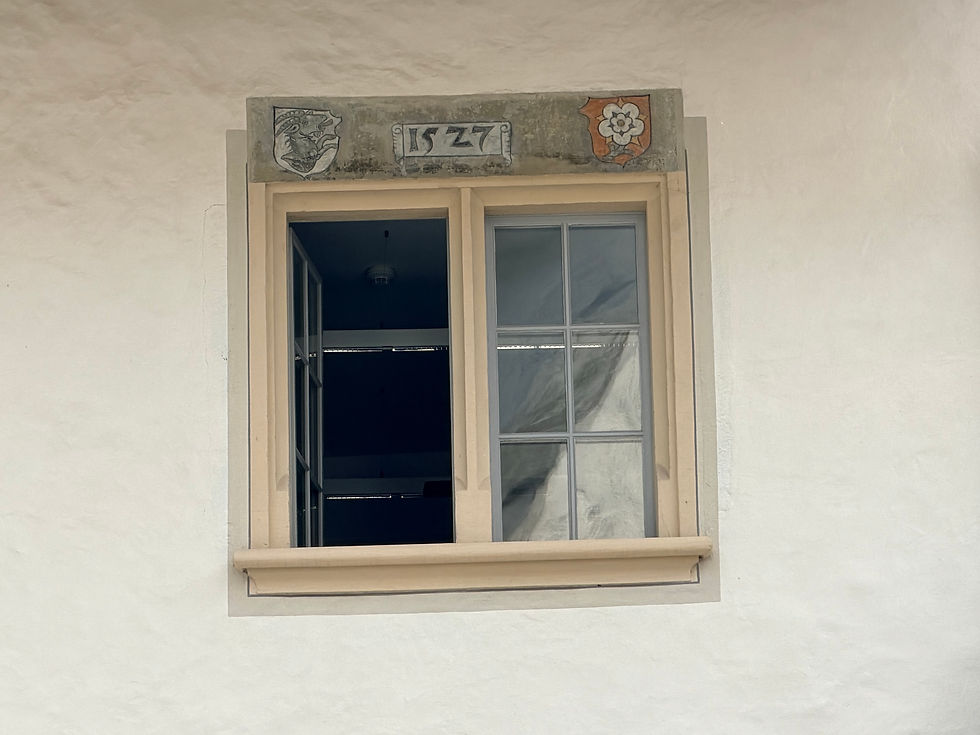


In the back of the church is a cemetery.

You can purchase flowers for the graves there.


How special to have your ggrave adorned with flowers.


Thought there would bbe more water lilies blossoming


Dragonflies love to dart here and there. When our friend Roger died, his wife always thought of him when she saw a dragonfly. I said hello to him today.


Lit candles for people and wrote a page of prayer intentions for people. Michael and I keep family and friends in our prayers.


Parked outside the church. It attracted attention.

Scottsdale is a sister city of Interlaken


My next stop was at the Japanese Garden


Created in 1995, the Japanese Garden of Interlaken is close to the old monastery and castle (with its castle church) and the Catholic church. Dubbed the Garden of Friendship, the garden is a gift from Interlaken’s Japanese twin town of Ōtsu.
With its pond and pavilion, the Japanese Garden of Interlaken reflects the landscape in which it stands. Located next to the Hotel Interlaken, the garden symbolizes the roaring waterfalls and deep ravines of the Bernese Oberland; the Shinji pond represents lakes Brienz and Thun. As you walk through the garden, a wealth of detail emerges: every element has special meaning and symbolism according to the Japanese tradition.


Carp are cold water fish, and their ability to survive and adapt to many climates and water conditions allowed the domesticated species to be propagated to many new locations.


Koi, literally carp, or more specifically nishikigoi, literally 'brocaded carp, are colored varieties of carp that are kept for decorative purposes in outdoor koi ponds or water gardens.
Koi is an informal name for the colored variants of carp kept for ornamental purposes. There are many varieties of ornamental koi, originating from breeding that began in Niigata, Japan, in the early 19th century.
Several varieties are recognized by Japanese breeders and owners, distinguished by coloration, patterning, and scalation. Some of the major colors are white, black, red, orange, yellow, blue, brown and cream, besides metallic shades like gold and silver-white ('platinum') scales. The most popular category of koi is the Gosanke, which is made up of the Kōhaku, Taishō Sanshoku and Shōwa Sanshoku varieties.


The garden is a commemoration of one of Interlaken's sister cities, Otsu.


Electric vehicle

Keeping Interlaken tidy and clean


Contest number 2.
What was my favorite thing to see today in Interlaken?
Entries must be submitted by Sunday, August 31, 2026 at noon Pacific Daylight Time.
Good Luck!!!!


Comments